By Eamon Dyas
Early European use of Russian oil and gas
On 18 December 1958 a decision was taken at the 10th session of the Soviet Council
of Mutual Economic Assistance (known as Comecon). The decision was that Soviet
Russia and other members of the Soviet bloc construct what was to become one of
the world’s longest oil pipelines. Although it could not be known at the time, that
pipeline went on to influence the energy situation in Europe over the next 65 years.
The completion of the pipeline became part of the Soviet Union’s Seventh Five-Year
Plan. However, at the time the Soviets continued to suffer from steel shortages and
did not have the technical knowhow to build the wide diameter pipes and large
compressors necessary for the transit of oil through long-distance pipelines. In order
to overcome those difficulties it was necessary to involve outside resources and
expertise in the project and this resulted in the formation of Soviet partnerships with
several Western governments and companies.
The entire pipeline became operational in October 1964. In the meantime
Czechoslovakia was the first country to receive oil via the pipeline in 1962, Hungary
was next in September 1963, Poland in November 1963 and East Germany in
December 1963. By the time of its completion 40% of the requirements for large-
diameter pipes had been purchased from West Germany and Sweden.
This pipeline, which was called the Druzhba (meaning friendship) pipeline soon
became the means by which Russian oil also found its way to European markets and
those markets became more demanding in the aftermath of the Arab oil embargo in
the 1970s. But, as we shall see later, it was a development which the United States
did all it could at the time to sabotage.
Just as the involvement of the European market in Russian oil began with the
development of the energy infrastructure for the Soviet bloc so too was the case with
gas. Khrushchev’s Sixth and Seventh Five-Year Plans involved a need to invest more
in the exploitation of natural gas. This was eventually to result in the construction of
new and more extensive networks of gas pipelines to be built across the Eastern bloc,
with the Trans-Siberia pipeline forming its basis. Before that however, there was the
Soyuz pipeline which was built between 1974 and 1978 connecting the Volga region
with the Bratsvo distribution network.
However, before that, the first supplies of gas from the Soviet Union had begun to
reach Western Europe in 1969 through a range of shorter networks. Deals
involving modest volumes of gas were struck with Italy in that year and West
Germany in 1970, 1972 and 1974. The Trans-Austria Gas (TAG) pipelines connected
Czechoslovakia with Austria and Italy in 1974 and the more ambitiousMitteleuropäische-
Gasleitungsgesellschaft (MEGAL) pipeline, constructed from1974
to 1979, linked up with Austria, Germany, and France. By this point
negotiations were already under way between France, Germany, Italy and the Soviet
Union for what was to become, and continues to be, the most controversial gas
pipeline constructed in the Soviet era.
The proposal was mooted in 1978 to construct a gas pipeline linking Western
European customers with the newly developed Urengoy gas fields in Western
Siberia.
It was known as the Trans-Siberian pipeline (also known as the Urengoy-Pomary-
Uzhhorod pipeline). The proposal was to link it with the existing Bratsvo network via
the Kursk Oblast and Sumy in Ukraine making a 4,500 km route from Western
Siberia to Czechoslovakia, Poland, East Germany, Bulgaria, Hungary, Yugoslavia
and Romania.
Just like the Druzhba pipeline was to form the backbone for the transit of Russian oil
to wider Europe, the Trans-Siberian pipeline was to serve the same purpose in the
case of gas. And just like the Druzhba oil pipeline the Trans-Siberian gas pipeline
would require the participation of Western investment and technical knowhow. In
July 1981, a consortium of German banks, led by the Deutsche Bank, and the AKA
Ausfuhrkredit agreed to provide 3.4 billion Deutsche Mark’s in credits for the
construction of compressor stations. A group of French banks together with the Japan
Export-Import Bank (JEXIM) later made finance agreements relating to the funding
of the project. This funding enabled the Soviets to sign contracts with Creusot-Loire
of France, John Brown Engineering of Britain, Nuovo Pignone of Italy, AEG-
Telefunken, the German industrial conglomerate, for the supply of wide diameter
pipes, as well as Dresser Industries of the US and Japan Steel Works. The Japanese
company, Komatsu, supplied the expert personnel relating to the pipe laying work (the
appearance of which may have been the source of some US propagandists claiming
that the Soviet Union was employing Vietnamese slave labour on the project).
And as was the case with the earlier use of Russian oil in western Europe the United
States set out to do all it could to sabotage this development from the outset.
Early efforts by the United States to disrupt Europe’s commercial relationship
with Russian energy
The United States Government witnessed these developments at the time with
profound anxiety. The fear was that the growing trade relationship between Europe
and the Soviet Union would at some point lead to the emergence of a Europe with the
potential to move away from US influence. Whereas the US had helped Europe to
ward off the ideological influence of the Soviet Union it was no longer confident that
it could prevent an influence that had its basis in commerce. US anxiety had become
manifest at the outset of the construction of the Druzhba pipeline when it attempted to
strong-arm Western companies from assisting in its construction.
“[The] tension between the United States and its European allies grew
appreciably during the construction of the Druzbha pipeline. In 1962, three
West German firms signed contracts to supply an estimated 163,000 tonnes of
large-diameter pipe to the Soviet Union, a deal valued at $28 million. However,
the United States attempted to scuttle the Soviet project by pressurising its
allies to cancel their shipments of pipes. At first, US policymakers channelled
their complaints through the Coordinating Committee for Multilateral Export
Controls (CoCom), a multilateral institution founded in 1949 to stop the
transfer of dangerous technologies to the Communist bloc, but they were
unable to create the necessary consensus to add pipes to the list of banned
export items. Instead, the United States worked through the machinery of the
North Atlantic Treaty Organisation (NATO), where a vote was not necessary.
On November 21, 1962, the NATO Council passed a secret resolution that
strongly encouraged member states to immediately halt the export of large
diameter pipes to the USSR and its allies. The German government complied
with the resolution but faced a political crisis at home for doing so. However,
the embargo did not last long as Britain and Italy chose to interpret the NATO
resolution as a recommendation rather that an order and fulfilled their contracts
with the USSR. Non-NATO members Sweden and Japan also resisted
American pressure. This incident demonstrated that although energy
technologies were a source of leverage over the USSR and formed the basis of
East-West cooperation, exercising it for political purposes was a challenge
because it required unanimity among Western countries.” (Pipeline politics
between Europe and Russia: a historical review from the Cold War to the Post-
Cold War. By Jae-Seung Lee and Daniel Connolly. Published in The Korean
Journal of International Studies, April 2016).
Although the NATO embargo, because it proved ineffective, ceased to operate in
1966 the United States maintained its opposition to any significant cooperation
between Europe and Russia particularly in the field of energy supplies.
Washington’s concerns gathered pace in the aftermath of the Soviet Union’s military
involvement in Afghanistan in 1979. In response to that involvement the United
States once more imposed sanctions on the Soviet Union which it expected its
European allies to abide by. However, by 1980 the attractions of trade with the Soviet
Union was proving too tempting for many European businesses and there was a
gradual fraying of the US-imposed sanctions. In the wake of intense American
opposition several contracts were signed by the end of July and late November 1980
between West German banks and businesses and the Soviet Union on the financing
and supply of compressor stations as well as the price and amount of gas to bedelivered to
West Germany.
Under pressure from the growing disregard for US sanctions by many European
businesses, British businesses were finding themselves in danger of being pushed out
of the lucrative Soviet trade. The problem was summed up by Ronald Scrivener, head
of the British-Soviet Chamber of Commerce:
“A factor in this process has undoubtedly been the sure knowledge that
Britain’s political allies, but commercial rivals, have been less hesitant in
resuming government contacts and filling the trade gaps left by the British and
the more resolutely hard-line Americans who cut exports to Russia by 67% in
the first nine months of 1980. Mr. Scrivener points to the activities of the West
Germans, Italians, French and Japanese. The more diplomatic United Kingdom
made officials can only mutter darkly.
“Each of these has retained or re-established trade links with the Soviet Union. A
number of large contracts have been signed or are in the offing. They include a
£33m heavy vehicle deal involving Fiat Allis; a trade agreement between the
Russians and Rhone-Poulenc, the French chemicals group; and continuing
negotiations on the Siberia pipeline project with groups such as ENI, of Italy
and Ruhrgas, of West Germany. Various Western nations have indicated their
willingness to provide credit for the gas line.” (‘Thaw begins in British-Soviet
trade’, by John Huxley. Published in The Times, 23 January 1981.)
Nonetheless, in the meantime some British companies had continued to trade with the
Soviet Union. The Times article again:
“For the time being British companies have continued to show the flag in a
variety of markets. An examination of recent contracts notified to the British
Overseas Trade Board gives an indication of their diversity – wrapping
supplied by Siat Packing Systems, of London; rescue equipment worth
£120,000, supplied by RFD Inflatable of Godalming; lathes, valued at £1.4m,
by Wickman Automatic Lathes, of Coventry; plastics and packaging machinery
for a margarine factory, worth £2m, supplied by John Waddington, of Leeds.
“By far the biggest deal done over the past 12 months was that concluded by
ICI last November. The chemicals company, which in 1979 imported products
– mainly oil and naphtha – from the Soviet Union, signed a general trading
agreement expected to boost its sales to Russia by about £30m a year. It will
run for 10 years.
“The deal was signed, on behalf of the Russians, by Mr. Vladimir Sushkov, the
Soviet deputy foreign trade minister. This indicated the extent to which the trade cold
war between Britain and the Soviet Union had thawed.” (Ibid.)
But it was the thawing of European attitudes in the face of US opposition to Europe’s
involvement in facilitating the importation of Russian oil that was significant. The
previous week Sushkov had addressed a conference organised by the London
Chamber of Commerce in which he said: “Moscow welcomed participation by British
companies in offshore oil, coal, agriculture, synthetic fibres and machine tools.
Machinoimports, the Soviet State trading organisation had already begun talks with
Rolls-Royce, GEC, Davy International and constructors John Brown on a large
pipeline project.” [an obvious reference to the Trans-Siberian pipeline – ED]. It was
in response to this situation that the Thatcher government dispatched Gavin Dick, the
Under-Secretary for Trade to Moscow at the end of January 1981 in what was seen as
an attempt to normalise the trading relationship between Britain and the Soviet
Union.
Washington’s response was not slow in coming. Within a year, the United States
found a new excuse to re-energise its sanctions policy on the Soviet Union. This took
place in the aftermath of the imposition of martial law in Poland on 13 December
1981 for which Washington held the Soviet Union accountable. And as had
previously been the case the main focus was European involvement in the Trans-
Siberian pipeline. In a statement which continued to be used in the same context for
the next 40 years the US expressed concern that any further reliance on Russian gas
would endanger the security of Europe.
In December 1981 President Ronald Reagan announced sanctions prohibiting
American companies from exporting oil and gas machinery and technologies to the
Soviet Union. The immediate impact of this was to block the sale of 200 American-
built pipe laying machines to the Soviet Union – machines that were to be used in the
construction of the Trans-Siberian pipeline. However, there were other aspects of this
prohibition that were to impact European industry. In a report with the heading “US
threat to Siberia pipeline” The Times reported on the measures being taken by
Washington to prohibit the issuing of export licences for components of the General
Electric Company that were used in the construction of the pipeline. The company
had been supplying compressor turbine parts to a subsidiary of AEG Telefunken of
West Germany, John Brown of Britain, and Nuoro Pignone of Italy.
At this time John Brown Engineering had a contract to build 21 of the 125 gas
turbines ordered by the Soviet Union for installation in 41 compressor stations. As far
as the impact of the US attempt to stifle American company involvement it appears
that the subsidiaries of US companies undertaking that work in Europe decided to
continued to operate on the understanding that the sanctions were not retroactive.
“The British company [John Brown Engineering] said it understood that
General Electric had not stopped production. Construction of the turbines was
continuing. Only General Electric parts could be used in the John Brown turbines.”
(US threat to Siberia pipeline, The Times, 9 January 1982).
And as far as the purchase of Russian gas was concerned:
“France will resume negotiations with the Soviet Union to purchase Siberian gas
despite its concern over Poland. A delegation from Soyugaz Export is due to meet Gaz
de France, the French gas utility in Paris on January 18 to discuss the purchase of
8,000 million cubic metres a year of additional gas.
“The French Government does not believe that the purchase will create any
dangerous dependence on the Soviet Union.” (US threat to Siberia pipeline,
The Times, 9 January 1982).
The European response was to question the American sanctions and an article in The
Times even speculated about Washington’s motives in imposing those sanctions. It
did so in the following terms:
“But if the Reagan sanctions order of December 29 was intended to set a
worldwide example, it had a serious flaw. By cracking down on the exports of
high technology goods and oil and gas equipment it appeared loaded against
West European manufacturing and trading interests while leaving America’s
huge grain business with the Russians virtually untouched.
“Of the $3,700m worth of goods that America sells to the Soviet Union each
year, about three quarters are agricultural products against only $300m worth
of high technology exports. Although the President announced that he was
postponing negotiations on a new long-term grain agreement, the
administration has already allowed the delivery of 23 million tons of grain to
the Soviet Union this year.
“It has been suggested that a grain embargo should be imposed if conditions in
Poland deteriorate but the US Department of Agriculture has been actively
reassuring the midwestern farmers since the Polish military takeover that they
will not lose the lucrative Soviet market.
“What, therefore, are the Europeans to make of the American sanctions policy?
Is it a deliberate move to scotch European industries’ export opportunities
while midwest farmers continue to make hay? Or is the apparent inconsistency
between the approach to sanctions on industrial and agricultural products just
another instance of an administration rooted in middle America and on the
West Coast picking up a blunt instrument in response to domestic pressure
without thinking of the impact on the European allies? There is probably some
truth in both these views.” (How Reagan’s sanctions force Europe’s hand, The
Times, 11 January 1982).
The arbitrary imposition of sanctions imposed by the US in December 1981 was done
with no regard to the economic welfare of Europe. It is worth noting here that the
value of the trade in energy between Europe and the Soviet Union at the end of 1981
was becoming a critical component in the economic well-being of Europe. In
November 1981 the West German gas distributor Ruhrgas finalised several long-term
agreements with the Soviet Union valued at $45 billion over their lifetime. This was
based on the relative economic advantages offered by the Soviet Union when it came
to price. At the time, the chief executive of Ruhrgas, Herr Klaus Liesen, was at pains
to emphasise that the price of the gas supplied by Russia was below “the £2.90 per
million thermal units which Norway has demanded for gas from its Stat Fjord field”
(The Times, 21 November 1981).
The reunification of Germany led almost immediately to the creation of Verbundnetz
(VNG) from the East German gas company Schwartz Pump. This was created with
funding from the West German companies Ruhrgas, Wintershall and BEB as well as
other international gas companied. Over the following years billions of DM
investments poured into a project to create a rationalised gas network extent across
the united Germany and the results of this can be seen in the dramatic figures relating
to the pattern of domestic gas use in Germany.
“By 2000, town gas had been phased out and more than 90% of total
consumption was high CV natural gas. In 1989, 73% of residences had been
heated with coal and 21% by district heating based on solid fuels; by 1998, the
share of coal had fallen to 10%, direct gas heating was 44% and district heating
based on gas was 21%.” (Gas pipeline co-operation between political
adversaries: examples from Europe, by Jonathan Stern, director of Gas
Research, Oxford Institute for Energy Studies. Published by Chatham House,
January 2005, p.5)
No doubt this project was facilitated by the growing influence of the environmentalist
lobby in Germany. Having been founded in January 1980, by October 1998 the Green
Party was sharing power in the Social Democratic government of Gerhard Schröder
(the leader of the Greens and one-time close friend of Daniel Cohn-Bendit, Joschka
Fischer held the position of vice-Chancellor and Foreign Minister in the government
and went on to become an enthusiastic European federalist). This was also something
that went beyond the domestic energy usage in Germany. With natural gas providing
a more environmentally friendly method for producing steel than the traditional coal-
fired blast furnaces the years immediately following the 1981 agreement continued to
produce a political environment in Germany which tended to favour the ongoing
relationship between German industry and Soviet and then Russian natural gas.
Ii was in this political and economic environment that the US continued its scare-
mongering arguments (later taken up by the EU Commission) based on the assertion
that its energy relationship with the Soviet Union and later Russia left Europeaneconomic security vulnerable to manipulation by the providers of that energy. At the
time, in the early 1980s, when nearly two-thirds of Soviet hydrocarbon exports went
to a market consisting of West Germany, Italy, France, and Finland – four
European/EEC partners – the Europeans countered that this in turn meant that the
Soviet Union’s economy was becoming symbiotically dependent on its European
energy market and it was therefore highly unlikely to engage in any serious
commercial brinkmanship likely to lead to it developing a reputation as an unreliable
economic partner. And even the Chatham House article quoted above, admitted that
“By the time the Berlin Wall came down in 1989, followed by German
reunification, Soviet deliveries [of gas – ED] already accounted for more than
30% of Federal Republic of Germany gas demand and there had been several
years of supplies to West Berlin without any problems.” (Op. cit., p.3)
But just as today with Russia, the main concern of Washington’s European policy
was not with the well-being of the European economies but with weakening the
growing symbiotic economic relationship between the Soviet Union and Europe.
Europe’s response to US sanctions in 1981
The main difference between the 1981 US sanctions imposed on the Soviet Union as
a result of martial law being instituted in Poland and the sanctions imposed in the
aftermath of Russia’s takeover of Crimea in 2014 (further expanded in 2022 after the
incursion into Ukraine) was the way in which Europe responded to the former as
against the latter.
Washington announced its sanctions against the Soviet Union at the end of 1981 and
expected Europe to follow suit but West Germany, France and even Britain failed to
do so. However, while refusing to implement the 1981 sanctions Europe was eager to
assure Washington that the refusal did not imply any divergence from the ideological
position which they all shared when it came to the Soviet Union. Europe’s position
was purely based on the disproportionate economic sacrifices which the
implementation of Washington’s sanctions would demand.
As to its ideological position, Europe continued to assure Washington that it shared
its antipathy to the totalitarian Soviet Union but it was unconvinced by the
justification which the US used in the formulation of its sanctions policy. That
justification rested on the claim that the Soviet Union was directly responsible for the
imposition of martial law in Poland on 13 December 1981 and this required a
response from the Free World. Both Germany and France refused to accept this
interpretation of the events. At the time, a West German government spokesman,
Kurt Becker, insisted that the government “did not share the American view that Russia
was the instigator of Martial Law in Poland. The West German Government believed
that the Polish authorities had acted autonomously.” (See: Germany: angry it was not
told, The Times, 31 December 1981). In fact, the spokesman added that had the
Soviet Union reacted to the crisis in Poland as it had been expected to act the
previous year by directly intervening then West Germany would have implemented
“joint contingency measures”
.
Similarly, France’s socialist government under François Mitterrand, argued that it
was wrong to claim that the Soviet Union was directly responsible for the declaration
of martial law in Poland and that sanctions imposed on the basis of that belief could
not claim a level of commitment from America’s allies that would have been the case
if that claim was shared. On the contrary, Jacques Huntzinger, the Deputy Secretary
for International Affairs in the Socialist Party stated “Although there is an obvious
Soviet involvement in the military coup d’etat of General Jaruzelski, this is not the
same as a takeover by the Soviet Government.” (See: “France baffled by US
approach”, The Times, 31 December 1981).It was this difference of opinion between
Europe and the US on whether the Soviet Union could be directly held accountable
for what had happened in Poland on 13 December 1981 that formed the political
basis for Europe’s insistence on placing its economic welfare above what the US was
demanding by way of sanctions.
In June 1982 Washington responded to the reluctance of Europe to fall in line
with its sanctions policy by expanding the terms of its sanctions. The new stipulation
meant that any machinery supplied by European companies to the Soviet pipeline
project which contained American components should be placed under embargo. This
included any components made in Europe under licence from such American
companies. A failure to comply with this new restriction would mean those
companies being blacklisted by the US Government.
The three turbine companies affected by this were the West German company AEG-
Kanis, a subsidiary of AEG-Telefunken, Nuovo Pignone, from Italy, and John Brown
Engineering from Britain as all had contracted with the Soviet Union to supply
turbines made under licence from General Electric of the United States. The total
threatened losses to these companies was valued at nearly $1,000 million (£581
million) but the real loss to Europe was something which The Times commented
upon when it said:
“The wider United States ban was aimed at delaying, if not rendering
impossible, the building of the pipeline that will carry vast amounts of Soviet
gas (40,000 million cubic metres a year for at least 20 years) to western Europe
under long-term contracts.” (UK group will lose $181 million Soviet contract,
The Times, 29 June 1982).
In terms of the implications for West Germany from any loss of the pipeline, the gas
supplier, Ruhrgas, had committed to take more than 100,000 million Deutsch Marks
(more than £22,000 million) worth of gas over the following 25 years as part of the
contract with the Soviet Union. Needless to say, such a loss would have had serious
implications for the future trajectory of the West German economy. Unsurprisingly,
the West German Chancellor, Helmut Schmidt, was the most assertive of the
European leaders in the face of this US threat. On a visit to San Francisco the
declared that, “ The pipeline will be built. And the British, the French, the Germans
and other Europeans will stick to the agreements which their firms have been making
with the Soviets.” (See: ‘US-Europe rift widens’, The Times, 24 July 1982). Schmidt,
further described the American President’s actions as an “attempt to apply
his own policy decisions to territories outside his jurisdiction”. This was a sentiment
shared by Lord Cockfield, the British Secretary of State for Trade, when he said that
the American embargo was “an attempt to interfere with existing contracts and is an
unacceptable extension of American extra-territorial jurisdiction in a way which is
repugnant in international law.” Compare that with what was to take place in 2018-
22.
US pressures Europe in 2018-22
Since the early 2000s there had been a sentiment within the EU Commission that
leaned towards the United States. The admission of the Eastern European countries to
the EU between 2004 and 2013 proved to have been the most visible pointers to a
change of emphasis in the politics of the EU from what George Bush described as
“Old Europe” to that of “New Europe”. The hostile attitude of the European
Commission towards the economic relationship of Europe and cheap Russian energy
since the early 2000s became increasingly obvious in the aftermath of the arrival of
“New Europe’s” influence on EU politics.
In the meantime Washington continued with its attempts to sabotage the
arrangements that had been evolving between Germany and Russian energy. As with
all sabotage strategies they rely to a large extent on anticipating the policies of their
targets. In that context it was not surprising when in late 2013 it was revealed by the
German magazine Der Spiegel that the US had been bugging Angela Merkel’s phone
from 2002 until 2013. (See: US Bugged Merkel’s phone from 2002 until 2013’, BBC,
27 October 2013). In 2002 Merkel was leader of the joint opposition in the Reichstag
having secured that position in the aftermath of the defeat of the Christian
Democratic Union by the Social Democrats in the election of September of that year.
Washington already knew what Gerhard Schröder represented as he had been
Chancellor of Germany since 1998 and had shown himself to have been a supporter
of Germany’s use of cheap Russian energy during his period in office. It seemed that
Washington was eager to know the private opinions of Merkel even before she
became Chancellor of Germany in November 2005. Merkel remained in office
untilDecember 2021 and it was under her Chancellorship that Nord Stream 1 was
officially opened on 8 November 2011.
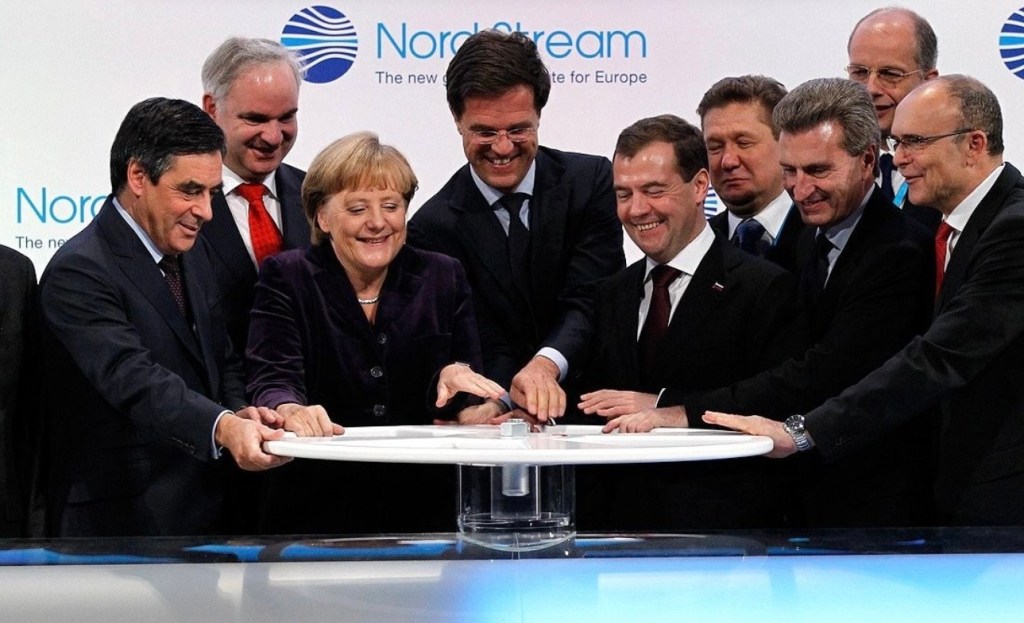
In Lubmin, Germany on 8 November 2011.
Dmitry Medvedev and Federal Chancellor Angela Merkel, alongside Prime Minister of the Netherlands and current head of NATO Mark Rutte, Prime Minister of France, François Fillon and EU Energy Minister, Günther Oettinger. Also out of picture to the left was the former German Chancellor, Gerhard Schroeder.
The significance of this pipeline was that it enabled natural gas supplies from Russia
to bypass traditional transit countries such as Ukraine and Poland – something which
freed Russian supplies of gas to Europe from the shenanigans which Ukraine had
gotten up to in 1999. At the time the BBC reported that “Chancellor Merkel described
the project as a ‘milestone in energy co-operation’ and the ‘basis of a reliable
partnership’ between Russia and Europe.” (Nord Stream gas pipeline opened by
Merkel and Medvedev, BBC, 8 November 2011). Merkel’s emphasis on the word
“reliable” could be seen to have been directed at the threats to the existing pipeline
posed by the corruption and ongoing instability of Ukrainian politics.
It was also under her Chancellorship that Nord Stream 2 was proposed and built. But
by then elements within the Washington establishment had determined to stop that
project at all costs. The same year as Nord Stream 1 was opened an evaluation of the
feasibility of Nord Stream 2 had been initiated. The project was put on hold by
Gazprom in January 2015 as a result of the operation of the existing pipeline at half
capacity due to EU sanctions on Russia over the annexation of Crimea in 2014. It was
revived by June with an agreement to build Nord Stream 2 signed between Gazprom,
Royal Dutch Shell, E.ON, OMV, and Engie. Germany granted Nord Stream 2 a
permit in January 2018 to access German waters and for landfall near Lubmin for its
construction and in May 2018 construction began at the Griefswald, the north
German end of the pipeline.
In October 2018, Angela Merkel, the symbol of Nord Stream 2 that its opponents
were glad to see the back of, announced she would be standing down as Chancellor in
2021. In November 2018 the US Ambassador to the European Union, Gordon
Sondland, issued a warning. “We have not yet deployed all the tools that could
seriously undermine or halt the [Nord Stream 2] project.” On 13 January 2019, the
German magazine Der Spiegel ran a story with the headline ‘US Ambassador
[Richard] Grenell sends threatening letters to German companies.’ The article goes
on to quote the Ambassador on the involvement of Germany companies in the
operation and construction of both Nord Stream 1 and 2:
“Ultimately, companies that support the construction of both pipelines are
actively undermining the security of Ukraine and Europe.”
And that:
“We [the US – ED] emphasise that companies involved in the Russian energy
export sector are participating in an activity that could entail a significant risk of
sanctions.”
As far as the response from the German government was concerned the article says:
“Within the German Federal Foreign Office, the letters were reportedly met with
bewilderment; Grenell’s approach, it was felt, does not align with standard
diplomatic protocol. Officially, however, the ministry has yet to comment.”
Then, in December 2019 the US House and Senate armed services committee agreed
on a defence bill that would force the Trump administration to sanction companies
that helped Gazprom, the Russian state-owned gas company, complete the Nord
Stream 2 natural gas pipeline.
“Lawmakers on Monday evening reached agreement on the 2020 National
Defence Authorisation Act, which includes the measures to punish companies
involved in Nord Stream 2, from Russia to Germany, and Turk Stream, a
Russian pipeline that crosses the Black Sea to Turkey.
“The decision marks the latest attempt to punish Moscow for meddling in the
2016 US presidential election.” (‘US lawmakers agree Bill to force Trump on
Nord Stream 2 sanctions’, Financial Times, 10 December 2019).
It was that election that made Donald Trump president and which the neocons and
globalists within the Democratic and Republican parties continued to find difficult to
accept. The irony of the US exerting such blatant and extreme pressure on European
businesses supposedly in retaliation for alleged Russian meddling in the 2016 U.S.
presidential election was no doubt lost on those proposing it.
Europe’s response to blatant US meddling in its affairs
The willingness or capacity of the EU to produce any effective response to the US
actions was to a great extent hampered by the fact that the main expression of the EU,
the European Commission, shared the concerns of Washington when it came to the
expansion of Russian energy in the European economy. Those concerns were not
based on an economic assessment but rather on a political one and it was well known
at this stage that the reasoning on the part of Washington was merely echoing the
position that had already been adopted by many in the EU and the EU Commission.
A BBC report at the time alluded to this when it said that, “Disagreements among EU
nations were so strong that, earlier this year, they even threatened to derail the [Nord
Stream 2] project entirely.” (‘Nord Stream 2: Trump approves sanctions on Russia
gas pipeline’, BBC, 21 December 2019). The disagreements which the BBC was
referring to was the events leading up to the agreement among EU ambassadors in
February 2019 to the wording of an amendment to the EU Gas Directive of July
2009. That 2009 directive had sought to eradicate situations where supply and
distribution of energy operated under the ownership or control of the same or related
companies within the EU. However, the original 2009 Directive did not explicitly
cover gas pipelines running between EU member states and a Non-EU (third) countryand
in November 2017 the EU Commission introduced a proposal to amend the 2009
Directive in ways that sought to explicitly include such pipelines. Aside from the EU
Commission the most enthusiastic exponents of the need for an amendment were the
likes of Poland and Romania (which assumed the EU Council presidency in early
2019) as well as other ex-Soviet bloc states that were seeking to restrict the further
encroachment of Russian energy into Europe via Nord Stream 2.
Negotiations surrounding the wording of the EU Commission amendment continued
between November 2017 and 2019 with the likes of Germany, Austria, the
Netherlands and Belgium opposing any amendment that would compromise the
ongoing relationship with Nord Stream. In February 2019, with neither side able to
secure a qualified majority in the European Council, France shifted its position to
support a wording of the amendment endorsed by Germany which brought Nord
Stream 2 under European regulations but did not threaten its continuance. The
relevant amendment to the Gas Directive was endorsed by the European Parliament
on 17 April 2019.
So, by April 2019, under a cloud of US interference, the EU managed to produce an
agreement which expressed the balance between the various political tendencies and
economic interests within the Union on the question of Nord Stream 2. Given that
was the case the main body representing the Union, the EU Commission, should have
been in a position to have defended it as such. However, beyond some anodyne
words of protest there was no substantial response to those US threats that could
equate with the strength of the response to the US threats to Europe in the early
1980s.
Then in December 2019, the Swiss company, Allseas, which had been involved in
pipe-laying operations for Nord Stream 2, announced it was to suspend its operations
on the project giving the excused that it feared US sanctions. This was followed five
months later, in May 2020, the German energy regulator refused an exemption from
competition rules to the project that required Nord Stream 2 to separate gas
ownership from transmission – this despite the leeway which the April 2019
amendment to the EU Gas Directive was supposed to have provided. This was
followed in August 2020 by Poland fining Gazprom 50 million Euros because it
claimed a lack of cooperation with an investigation launched by the Polish anti-
monopoly watchdog UOKiK. It was charged that Gazprom and companies financing
the project had broken Polish competition rules and had continued to work on the
pipeline without the permission of the government of Poland.
Despite these crude attempts to hinder the progress of the project the pipe-laying
work continued using Russian ships and on 20 July 2021 Angela Merkel felt she had
provided a breathing space for the project when she reached an agreement with Joe
Biden the US would only trigger sanctions if Russia used Nord Stream as a ‘political
weapon’ by cutting off Poland and Ukraine from Russian gas supplies. The
agreement further compensated Ukraine for the loss of transit fees that would resultfrom
Nord Stream 2 becoming operational. Then, out of the blue, Germany’s energy
regulator suspended approval of Nord Stream 2 on 16 November 2021 resulting in a
17% rise in European natural gas prices.
Less than a month later, on 9 December 2021, Poland once more decided to renew its
public pressure to have the project abandoned when the Prime Minister of Poland,
Mateusz Morawiecki, on a visit to Rome said “I will call on Chancellor Scholz not to
give in to pressure from Russia and not to allow Nord Stream 2 to be used as an
instrument for blackmail against Ukraine, an instrument for blackmail against Poland,
an instrument for blackmail against the European Union.” (Polish PM tells
Germany’s Scholz not to ‘give in’ over Nord Stream 2, Reuters, 9 December 2021).
The same Reuters report pointed out that, “Scholz’s predecessor Angela Merkel
soured relations with many central and eastern European countries by sticking to a
project they said would dangerously increase dependence on Russian gas. Now, with
a new administration in Berlin and regional tensions rising, Warsaw hopes Germany
could change tack.” And the report ends with a revelation that was to be an augury
for what was to come: “US officials have told members of Congress they have an
understanding with Germany about shutting down the Nord Stream 2 pipeline if
Russia invades Ukraine, a senior congressional aide said on Tuesday.”
This was confirmed from the horse’s mouth on 7 February 2022, when “Speaking
after talks with German Chancellor Olaf Scholz in Washington, Mr. Biden said the
US would “bring an end” to the Nord Stream 2 pipeline” if Moscow invades Ukraine.
(‘Ukraine crisis: Nord Stream 2 will end if Russia invades’ – Biden, BBC, 7 February
2022. And two weeks later Scholz did what Biden said he would do and he
suspended certification of Nord Stream 2 on 22 February 2022 under the excuse of
Russia’s recognition of the Donetsk and Luhansk republics. Two days later Russian
troops crossed into Ukraine with the result that Washington’s years’ long ambition
was realised and the Nord Stream 2 project was no more.
Casting our minds back to the early 1980s when the US used the excuse of the Soviet
incursions in Poland to threaten Europe with sanctions if it did not comply with its
policy toward of withdrawal of technical support for the construction of Russian
energy transmission networks we see a different Europe and a completely different
response.
The difference between the Europe of the 1980s and that of the EU in 2018-20 is that
in the 1980s the economic interests of nation states were more clearly capable of
being expressed within what was a more loosely arranged relationship between its
members and the central authority. The authority continued to represent the idea of
Europe that remained a vague and abstract concept that had not yet developed a
bureaucratic and political existence which was capable of influencing the perspective
of its member states. The event that shifted the Europe of then to what it has now
become was the collapse of the Soviet Union. It was that event which expanded the
perspective and ambition of Europe beyond the geopolitical block that it emergedfrom in
the aftermath of the Second World War. Europe became expansionist within
Europe and that inevitably involved it moving from the idea of itself which was
framed through its experience of the Second World War to one which became
increasingly influenced by the anti-Russian sentiment of the nations it was expanding
into.
It was in its facilitation of this that it found itself having to abandon its understanding
of its own history and replace it with one that was capable of accommodating its new
Eastern members – something that in turn inevitably led it to complementing the
perspective of the US. The point at which it could be said that the old Europe finally
gave way to the new Europe was in 2008 when the US pushed through, despite the
protestations of German and France, the invitation to Georgia and Ukraine to join
NATO.
This was a development which took place alongside what was happening in the EU
where what previously had been incapable of developing a sense of itself was now
evolving along lines that have been fashioned by the United States and its new
Eastern members. This has resulted in a Europe where all it possesses by way of
understanding itself is encapsulated in the only purpose which now provides it with
any coherence and that is the self-appointed protector of its so-called values when it
comes to Ukraine.
It has been on that particular altar that it has sacrificed the economic interests of its
members in favour of a political principle which has itself been shredded by its policy
towards the Israeli genocide against the Palestinians. In the process Europe has
become a collective of political entities that are no longer capable of perceiving their
respective interests except when viewed through the distortion of the EU collective
lens.
This is a malaise that has also spread deep into the body politic of the economic heart
of the EU as epitomised by the way in which Germany has failed to produce a
mainstream politician who can effectively represent the country’s economic interests.
In the face of US will and EU sentiment Germany has become a creature that is
slowly devouring itself. With no means of establishing where its actual interests lie it
has reverted to the deep ruts of its past memories and the political expressions of
those memories are the only ones that now enable it to span the chasm between what
it needs to do and what its EU perspective demands. Russia now provides it with its
only means of understanding itself.

