Andy Burnham's conference speech was a curious affair. He reiterated his view that the country took a wrong turn in the 1980s, when Margaret Thatcher set out to dismantle the post-WWII political settlement. "In 1945, we had the vision to win the peace. We had the bravery to make change. We built good homes, secure … Continue reading Can People Live on Hope Alone? Editorial
British Politics
Canvassing for George in Kentish Town.
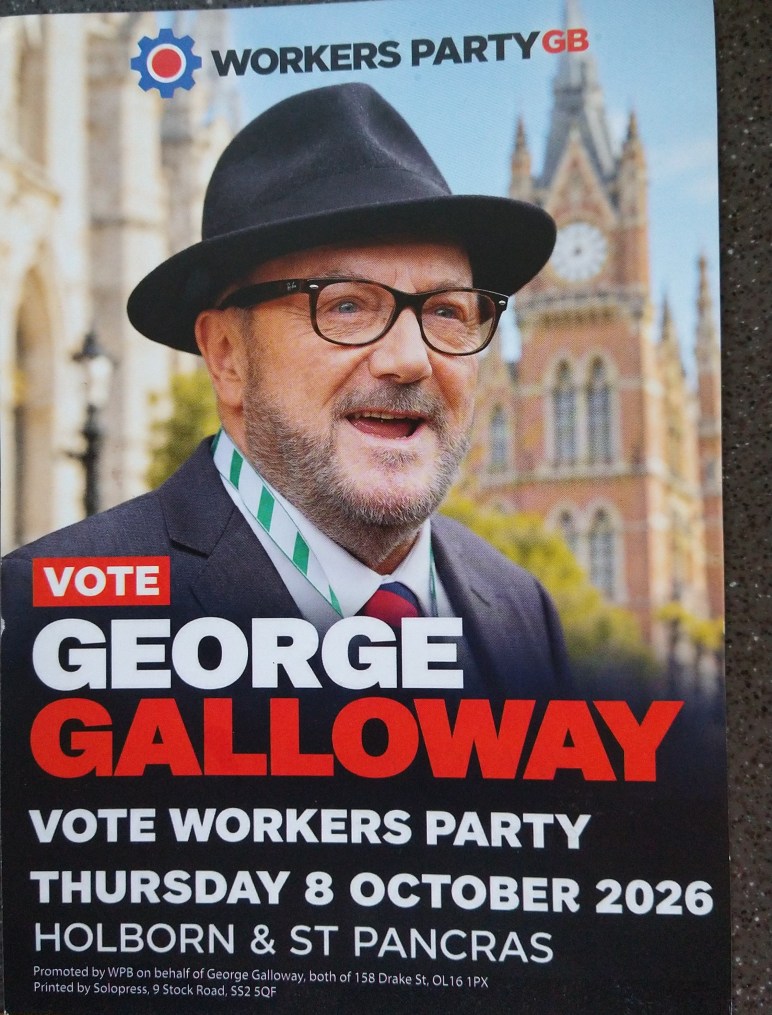
Today 24th September I spent two hours canvassing for George Galloway who is contesting the bye election on the 8th of October in Holborn and St Pancras constituencyIt was in a very pleasant wide road near Kentish Town West, with well kept small terraced houses obviously owner-occupied. The people I spoke to were young and … Continue reading Canvassing for George in Kentish Town.
Democracy et cetera
LETTER TO THE EDITOR Dear Editor, The article on “Democracy, et cetera” in the September 'Labour Affairs' helps to put Fascism in its historical context. In political discourse today it is treated as a transcendental source of evil that can be related to any situation irrespective of time and place and therefore becomes a meaningless … Continue reading Democracy et cetera
The Coming of Censorship in Britain. Liberal democracy in action.
Dave Gardner It is often proclaimed with pride by politicians and their media in the UK that we are privileged to live in a ‘Liberal democracy’ unlike the unfortunates in countries such as the Russian Federation and the People’s Republic of China who languish under ‘authoritarian regimes’. We enjoy a variety of competing political parties, … Continue reading The Coming of Censorship in Britain. Liberal democracy in action.
Tony Greenstein: The most important half-hour of my life
Aug 21, 2026 Below is the text of the closing speech Tony Greenstein prepared for the end of his trial at Kingston Crown Court. After a four-day trial ending on Friday, August 21 2026, Tony was acquitted of one count of inviting support for a proscribed terrorist organisation [Hamas] under Section 12(1) of the Terrorism Act … Continue reading Tony Greenstein: The most important half-hour of my life
Burnham’s story should have been Inequality, not Devolution—Editorial
If Andy Burnham is to have any hope of reversing the decline of the Labour Party he needs to have a fairly simple but compelling story. One good story would be inequality. He could say that he is going to reverse the inequality that has developed in the UK in the 47 years since Thatcher first came … Continue reading Burnham’s story should have been Inequality, not Devolution—Editorial
The Limits of Devolution—Editorial
In his speech in Manchester on 29th June, Andy Burnham made some interesting proposals. He wants all parts of the UK to be able to take greater public control of essential services like water, housing, energy and transport. He also pledges 10-year plans to bring down the cost of these essentials to individuals, families and … Continue reading The Limits of Devolution—Editorial
Burnham and growth through increased defence spending
By Eamon Dyas On Sunday 28 June the former Chief of the Defence Staff, Sir Tony Radakin, said in an interview with Laura Kuenssberg on BBC that whoever follows Keir Starmer as Prime Minister would have to operate “almost like a wartime Prime Minister” in the light of global threats. These comments were no doubt … Continue reading Burnham and growth through increased defence spending
Gabriel Zucman We need to tax the billionaires 2025
Translated into English 2026 A summary Catherine Dunlop At 65 pages, this international bestseller is a long article or short manifesto. The general idea is that taxing billionaires is no more revolutionary than establishing income tax; income tax is accepted now as a matter of course, even if at the time it was created (end … Continue reading Gabriel Zucman We need to tax the billionaires 2025
New National Security (State Threats) Bill
OUR PARTY parliamentary leader Jeremy Corbyn pledged to oppose the government’s National Security (State Threats) Bill yesterday as ministers started to rush the measure through Parliament. He warned that the Bill “is an alarming expansion of state power, and an escalation of the government’s chilling assault on the right to protest. “This week more than 100 … Continue reading New National Security (State Threats) Bill
Whether Burnham wins or loses, the future of the Labour Party is not guaranteed—Editorial
The Makerfield by-election is the most important by-election in recent years. It is almost a pre-run of the 2029 general election which may well determine whether the Labour Party survives. Makerfield has been represented by Labour MPs since its creation in 1983. Labour would typically get between 50% and 60% percent of the vote. It was a ‘Leave’ voting … Continue reading Whether Burnham wins or loses, the future of the Labour Party is not guaranteed—Editorial
Local elections—Editorial
It is a week away from the local elections that will take place in much of the England on 7thMay. Almost two years ago, the Labour Party won a landslide 411 seats in the July 2024 general election. The polls for the forthcoming local elections suggest that Labour will be in third place in many wards and … Continue reading Local elections—Editorial
Vote for the Workers Party in the May elections
Here is the Workers Party of Britain's 10 Point Programme, as adopted at its founding in 2019, followed by the manifesto. Workers Party of Britain – Ten Point Programme An end to imperialist wars and financial domination, starting with withdrawal from Nato. Rebuild British industry and abolish the anti-worker ‘rationalisation’ that puts profits ahead of people to … Continue reading Vote for the Workers Party in the May elections
Was Fianna Fáil ‘slightly fascist’ in the 1930s?
James Connolly was the only Labour leader in the British state who was explicitly Marxist in his general framework of understanding and who engaged in revolutionary action against the State. He was killed for his revolutionary attempt by a Coalition Government which included the founder of the Labour Party, Arthur Henderson, who was in the process … Continue reading Was Fianna Fáil ‘slightly fascist’ in the 1930s?
Competitive Parliamentarianism Isn’t Essential for Democracy
By Gwydion M. Williams Parliaments of the rich, for a rich minority Elections as a path to Civil War Humans are not natural democrats or natural sharers Parliaments of the rich, for a rich minority England has been parliamentary since the 14th century. But only in 1688 was it settled that the monarch could not rule without … Continue reading Competitive Parliamentarianism Isn’t Essential for Democracy
“The Fraud: Keir Starmer, Morgan McSweeney and the Crisis of British Democracy” (Paul Holden)
BOOK REVIEW David Jackson “The Fraud: Keir Starmer, Morgan McSweeney and the Crisis of British Democracy” (Paul Holden) Part 3 This is a lengthy, significant and substantial book of almost 550 pages. It is supported by nearly 800 footnotes, which the author decided to place online. I believe that to do it proper justice required more … Continue reading “The Fraud: Keir Starmer, Morgan McSweeney and the Crisis of British Democracy” (Paul Holden)
Virtue March
CAN THE LEFT MARCH FOR VICTORY WHILE LOSING THE WORKING CLASS? How the British Left Traded Solidarity for Virtue Signalling, and Why the Working Class Is No Longer Listening Paul Knaggs, Labour Heartlands There is a speech circulating in left-wing circles in Dublin that ought to unsettle every socialist in Britain. Not the kind of … Continue reading Virtue March

