Review of the 2025 Film
Catherine Dunlop
This is a film set in Iraq in the early nineties, at the time of sanctions. It was written and directed by Hasan Hadi and produced by Western backers. It won the Caméra d’Or at the Cannes festival’s parallel section, the Directors’ Fortnight. The director, Hasan Hadi, has taught film in the U.S.
I was amazed that a film should be made telling the world what a bad man Saddam Hussein was and perhaps justifying the US/UK attack. In fact it’s nothing like that.
If anything, it’s a film about the reality of sanctions. It should then be a grim film, but it’s not. The story is grim, but it’s played by two nine year old children who are charm personified, living in the marshes of Mesopotamia as they were then.
They live in a wonderful water landscape and beautiful reed houses. The little girl Lamia paddles to school in her boat; we see her navigating along, with other boats all gliding beautifully along under a blue sky. The boat looks like no ordinary ‘canoe’, its shape is uniquely elegant.
The story is built to show the reality of sanctions, when an extra burden is placed on impoverished households such as Lamia and her grand-mother’s, by the obligation to celebrate the President’s birthday. The school must celebrate it with an event on the Saturday that includes food and in particular a cake. The teacher threatens the pupils chosen by lot for the duty of bringing those foods with very serious consequences. The children know what these consequences are, as they were visited on another child and his whole family on a previous occasion.
Lamia has to make the cake, and the first problem is buying the ingredients. There is the absolute minimum in the house, when someone brings an apple it is a rare treat for the girl. Needless to say, she does not get to eat it. Lamia and Bibi the grandmother get a lift to the nearest town; they become separated but Lamia finds a friend from school; together they manage to scrape together the ingredients, getting robbed and swindled along the way.
Sanctions are mentioned explicitly several times, at school the children are made to chant ‘Despite sanctions that make us poor, we follow you Saddam Hussein for ever’. At other times, shopkeepers explain they have nothing because of sanctions. At the hospital where Bibi is taken after collapsing with a diabetes crisis, doctors can’t save her because the required medicine is unobtainable due to sanctions. The grand-mother dies.
The viewer is meant to understand that the despicable behaviour of some of the people the children come across is caused by the strain of sanctions. I felt that the film was an illustration of the word ‘sanctions’, a concept which can easily remain a bland abstraction. The grandmother had planned a foster mother for Lamia, knowing that her own life was threatened without diabetes treatment. That is what being under sanctions means.
But it’s not a lesson in geo-politics because it doesn’t feel like a lesson. The story makes sense, and it becomes a series of adventures which are believable and where the two children play an interesting role; the sequence when they fall out and quarrel momentarily is very well done. They are lively and courageous.
They play a game of ‘who blinks first is the loser’. When their school is bombed and they hide under their desks, they play it again.
This film gives you an idea of what life must be like in Iran today, and other countries subjected to this barbarous war practice.
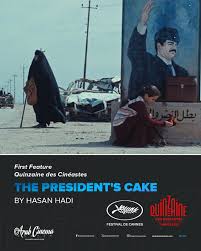
The President’s Cake | Official Trailer | Coming to GSC International Screens starting 4 March 2026
 Labour Affairs