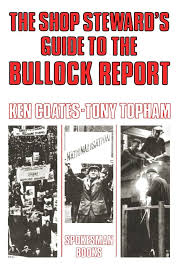
In the 1970s, the trade unions were so strong they had political power, as the media never stops reminding us. This power was such that a government report (the Bullock report) offered the unions an official role in deciding economic policy. Now the majority of workers are not in a union, and wages and conditions have declined precipitously. What happened? This is the question Eamon Dyas in tackling here.
Eamon Dyas
The condition of the working class and trade union movement in Britain is dire. The left has shown how impotent it is in its response to the current crisis of capitalism. That it has been incapable of mustering any meaningful response to the crisis is not the most serious thing. What is most serious is that it has shown itself incapable of debating the crisis in any meaningful way, let alone offering any sort of explanation. It is time to discuss and re-evaluate the position of the working class movement and its understanding of itself in the context of the current economic crisis.
The “Progressive” movement has long ago begun to have such a crisis of faith in itself, without the ability to put it into any coherent testimony. An important part of making coherent history of the movement is to appreciate the implications of the rejection of the Bullock report for the wider society and the full extent of the political significance of that rejection for the working class movement. Given that we have to deal with the kind of society that has emerged in its aftermath it is no longer enough to continue to perceive the world from a pre-Bullock working class perspective, as the kind of society that emerged post-Bullock is a very different thing from what went before.
The rejection by the trade unions (at the behest of its ‘progressive’ leadership) of the opportunity offered by Bullock was not only a betrayal of the working class movement, it was, in my estimation, an act which has recast the nature of the class struggle in Britain.
What passed with Bullock was not only the chance for the trade union movement to ensure that its individual members could exert influence in the board rooms of their employing companies. In other words, it was not just an opportunity for the employees of individual enterprises to sit in boardrooms, but the opportunity for the British trade union movement to accept responsibility for the strategic direction of the private sector of British industry. The existence of companies where workers have a say in boardroom decisions has a long pedigree in Britain and there are several examples of successful companies operating on such lines even today. The John Lewis Partnership is probably the best known. But what Bullock offered was not just individual employees exerting influence in their immediate employer’s boardroom but the opportunity for the trade union movement to exert control over the wider economy. Bullock was not just a matter of industrial relations where the idea of worker partnerships has long been mooted as a means of improving productivity. This was a class thing. It was a potential seismic shift in the balance of power in the wider society from capital to labour or at least for more control of labour over capital. In such a situation and given the power of the trade unions in the wider society at this time such a concession would inevitably have presaged a significant diminution in the ability of the then ruling class to continue to dictate economic policy.
However, political development that cannot be situated historically cannot be traced through its life to any useful conclusion in the day and daily here and now. Consequently, we are compelled to examine the relationship between the “day and daily here and now” with what happened back in day and daily there and then.
The obvious thing to begin with is that the circumstances which gave rise to the situation in Britain in the 1970s were quite unique and very un-British. The accidental arrival of someone of the calibre of Ernest Bevin in the leadership of the British trade union movement and his rise to a position of almost absolute influence over it as a result of the war could not be anything but out of the ordinary. But that does not explain why the trade unions continued for three decades after the war to wield such influence and power in British society. In fact, its power in the 1970s was unprecedented and had actually increased from what it was after Bevin’s death. There may be no direct line between a Bevin influenced trade union movement after the war and the trade union movement in the 1970s. Bevin’s influence continued no doubt, but only in pockets and his thinking had ceased to define the leadership of the movement by the late 1960s – the time when the “Progressives” began to assume its tutelage. But it was only after this that the real industrial power of the British trade union movement began to manifest itself on the scale that compelled the emergence of the prospect of the seismic shift represented by the Bullock proposals. Undoubtedly there was a momentum which the “Progressive” leadership inherited but there must have been something else which culminated in the Bullock proposals. Otherwise we are forced to concede that the “Progressive” leadership had the nous to march the movement to the top of the hill before examining the terrain and then deciding to march it down again. Of course such a thing is possible but then the hard slog to the top of the hill cannot be credited to Bevin. Alternatively, it could be said that the momentum of the post-war Bevin influence propelled it to the top of the hill but, if that is the case, why did the arrival at the top of the hill not take place when Bevin’s influence was much stronger in the immediate aftermath of the war?
What is more likely to have caused this is a combination of the Bevin legacy, the blind belief of the left “Progressives” in the creation of social disruption as a forerunner to revolution and something dark in the woodshed of the capitalist economy. While attention has been focussed on the first two, very little attention has been paid to what was happening in the wider British economy at the time. We, the Bevin Society, like the “Progressive” left, have contented ourselves in exploring the event in terms of the classic eternal battle between Capital and Labour and as a consequence have, to a large extent, had nothing to say about the current crisis beyond reporting it from a vaguely “Progressive” perspective. Without fully understanding the wider significance of the events surrounding Bullock we cannot completely understand what it is that is happening in the “day and daily here and now”.
The rejection of the Bullock proposals marked a watershed in British capitalism because it represents the last opportunity this side of a revolution to regenerate industrial capitalism. It was industrial capitalism where the dark corners of the British economy could be found -– where, deprived of the light of proper investment, it had been in decline for a long time. As a result of that decline it had lost vigour and long conceded the economic leadership of the economy to financial capitalism. It was against such a foe that the post-1960s trade union movement under its “Progressive” leadership made such headway. The citadel of industrial capitalism had been stormed only to find it was bereft of defenders and the real force behind the defenders of class privilege were elsewhere.
Economically what was on the table with Bullock was not a revolution but the opportunity for a revolution. In the meantime, it offered the trade union movement the chance to determine the strategic direction of the private sector of British industry. It was the opportunity for the trade union movement to determine the future by operating capitalism in a way more conducive to working class power. But it was more than that for it offered the opportunity for the future strategic direction of British industry to be driven by a vigorous and purposeful agenda – something that the “Captains of Industry” had, up to that point, failed so miserably to do. In providing this opportunity Bullock opened up two possible futures not only for the British working class but for the wider economy. We can’t tell with any accuracy, what kind of future would have unfolded in the event of the trade union movement grasping the opportunity proposed by Bullock, but we can tell what type of future actually happened in the aftermath of its rejection and, unless we are all wasting our time, all we can say is that the potential future that might have been heralded by the trade union movement’s adoption of Bullock would have been entirely different from the one that we have actually inherited.
What is it that we have inherited?
Whatever else can be said about the characteristics of post-Bullock British governments, none of them could be said to have been pro-manufacturing. Governments prior to Bullock were not exactly active in encouraging the sustainability of the manufacturing sector, but they did not manifest the same drive to destroy it as was evidenced after the first years of Thatcher’s arrival. Even Heath was prepared to provide assistance to it albeit in a way which was not designed to resuscitate it.
Although it was not part of Thatcher’s election manifesto to deliver the coup de grâce to any prospect of a British manufacturing revival the logic of the position she adopted was to lead inevitably to such a strategy. Ostensibly Thatcher went into the election on a programme to tighten monetary and fiscal control as a means of reducing inflation, roll back the State’s involvement in the economy, and cut welfare payments to incentivise recipients to accept low paid employment. However, the real objective was to destroy the social power of the trade union movement. At the time of Bullock, the real power of the British ruling class had not been held by the “Captains of Industry”. For a long time that power had actually been held by the “Lords of the Universe” of the City of London.
The “Lords of the Universe” of the financial establishment knew they had been fortunate in escaping the possibilities of Bullock and were determined that there would be no second chance for the trade union movement to revisit that particular well. The balance of power between Capital and Labour in the declining industrial sector had been threatened by the growth in the social power of the trade union movement from the 1960s onwards and that in turn threatened the interests of the wider ruling class. From the viewpoint of the “Lords of the Universe” something radical needed to be done.
In that context the normal “Progressive” description of Thatcher’s anti-trade union agenda does not make sense and only views the thing in legalistic terms. The simple and obvious fact is that Thatcher could not have destroyed the trade union movement through the process of passing laws. Such laws could only represent a public statement of a position adopted by the government of the day. But laws are transient things and can easily be repealed in the event of a return of Labour after the next election or even the election following that or an election in twenty years’ time. The use of the law was never going to achieve the purpose for which she set out. What was required was the debilitation of the natural habitat of the most vigorous element of the trade union movement – its basis in manufacturing capitalism.
It was only by such action that the prospect of a resurgence of the trade union movement could be effectively neutralised. Thatcher’s anti-manufacturing policies were never going to effectively damage the basis of ruling class power in Britain as that had found its natural home in the financial sector and unsurprisingly she was not confronted by any coherent opposition from the capitalist victims of these policies (the head of the Confederation of British Industry expressed a half-hearted condemnation of Thatcher’s anti-manufacturing policies but his condemnation was nothing more than a gesture).
Although anti-union legal means were utilised by Thatcher these were only holding measures while her economic policies did the real work in systematically debilitating industrial capitalism. The central element in all of this was the transfer of the State’s resources from supporting and subsidising the ailing manufacturing sector to policies which encouraged and incentivised the financial sector as she set about unfettering the power of British finance capitalism.
The unfettering of finance capitalism operated on two fronts under Thatcher, the domestic and the international. On the domestic front she could simply have allowed the manufacturing sector to continue its slow incessant decline but that ran the risk of a resurgence of trade union influence before the tipping point between decline and debilitation could be reached. Alternatively, she could pursue measures which would hasten that decline. At this stage it should be said that Thatcher had no intention of actually destroying the British industrial sector. What she desired was its further debilitation to the point where it no longer was capable of sustaining the type of trade union forces it previously hosted and that is just what she did. One of the key components of this strategy was to encourage the further expansion of the financial sector through the creation of the “share-owning democracy” – shares in this sense not restricted to stockholding wealth but to shares in property wealth. Through this strategy the working class traditional disavowal of financial debt where prudence was the order of the day, was increasingly and systematically undermined by policies which encouraged/induced it to get into debt to banks, mortgages providers, insurers, etc. (Blair’s “stake-holder” creation and the introduction of university fees for the 60% of youth he planned to get into higher education was a simple continuation of this strategy).
In fact, the basis for this process had already been laid down before Thatcher’s arrival and it began through the arrival of the ubiquitous credit card. The first general credit card was introduced by Barclays in 1967 but the Barclaycard was initially only used by those already familiar with things like American Express so it was used in a fairly restricted market. In 1972 the Royal Bank of Scotland, NatWest, Lloyds and the Midland banks became partners in the issuing of the Access Credit Card in Britain. Again, however, the use and market for such things was highly restricted and it was not until the 1980s, after Thatcher came to power that any real traffic began to be established and it was during that decade that the British Access card (backed by British banks) was forced out by the American founded Mastercard and Visa cards. This was the direct result of the action of Geoffrey Howe in 1979 when he abolished Britain’s exchange controls. This measure sent out a clear message that he was looking to the finance sector for the future growth of the economy as the abolition was designed to encourage the investment of British capital in foreign markets. It also had the effect of encouraging the issuing of Visa and Mastercards by British banks and as these cards could now be used abroad, it generated a growing user base among the banks customers and found a ready market among the growing numbers of British working people taking holidays abroad at this time. By 1999, a couple of years after Blair assumed the Thatcher mantle, it was estimated that half of all British adults held at least one credit card. This was not a normal economic development as, outside the well-known tourist areas up to a few years ago, the use of credit cards hardly existed in most of Europe and indeed it remains the case in significant parts of Europe to this day. It was a peculiarly British phenomenon which the British successfully exported to the rest of Europe and the technology behind it was the progenitor of the explosion of online financial transactions that continue to grow at an almost exponential rate. Then, in 1980, the introduction of the nationally based “Right to Buy” scheme provided a significant domestic stimulus to the finance sector as working class families were encouraged to take out mortgages for the purchase of their homes. Between 1980 and 1998 around 2 million council homes were sold in this way. This had a knock on effect as the purchase of council homes was heavily subsidised by the government and sold at a knock-down price to the occupants. Within a relatively short amount of time many of these (and eventually most) in turn entered the property market as part of the stock of private dwellings when the new owners came to sell. At this point it was the real market value that determined their sale and this generated a further wave of involvement of the mortgage and banking providers. Inevitably there occurred a significant increase in house prices as this new property-owning class sought to move up the property chain causing a situation where the demand could not be met by the supply of the type of property next up the chain. Overall, the sale of council properties constituted a huge injection of capital into the economy but a capital that was generated not in the course of industrial production but in the course of financial transactions associated with property. Overall £18 billion was raised through council home sales but to this must be added the other things like the cost of house and contents insurance and the surge in DIY activity as the new home owners became sudden home improvement enthusiasts in the context of selling their new property. But as far as the Government was concerned it was the £18 billion raised from council home sales that it had control over and to ensure that this money did not find an expression in any productive activity the local councils were barred from using the proceeds to build more council homes and instead were compelled to spend it by paying off their debts to, none other than the banks! The banking sector now had possession of the golden triangle. It loaned money to the tenants, from whom it gained the repayment and interest revenue, the capital of this loan was then paid by the tenants to the local councils who in turn gave it back to the banks! In the wider economy a further £29 billion was raised through the sale of nationalised industries and again these purchases necessitated the involvement of the finance houses to raise the necessary funds through commercial conglomerations and joint investors and again, a good proportion of the money thus raised was paid back to the financial houses by the Government as it sought to bring down government debt. The actual benefit to the financial sector from all of this is impossible to calculate as the £18 plus £29 billion alone was worth more in today’s money than the entire EU Irish bailout and to this must be added the interest and loan charges it placed on those to whom it made the original loan as well as the income from the investments that came their way as a result of getting this money back via the local councils and the government intent on reducing their debt. The overall effect was the arrival in the financial sector of quantities of capital akin to a wave of Tsunami proportions and given the nature of financial capitalism, where money not utilised is viewed as dead money, this Tsunami had to flow somewhere. The result was the explosion of mergers and takeovers during the 1980s and 90s at home and abroad.
On the international front British financial capitalism was encouraged to invest directly in the wider world through the Big Bang legislation of 1986. This removed most of the more important restrictions on the London Stock Exchange as a direct encouragement to growth in the finance sector. The restrictions under which the London Stock Exchange operated were claimed to have been responsible for the usurpation of London by New York as the world’s main financial trading centre and the freeing of the Stock Exchange from such restriction restored London to its previous position of pre-eminence. However, it was this measure that really heralded the arrival of speculation and financial trading on the scale that has been a major contributory factor in the current financial crisis.
Manufacturing and the working class.
Why was industrial capitalism important for the working class movement? It was important because it represented the last stage in a line of production stretching back to peasant economies. It had retained within itself the echoes of distant social relationships generated between people and things, between producer and product. From the days when feudal peasant economies produced food as their end purpose to the days when industrial workers produced any range of products as their end purpose this line of tangible end result continued. The making of things in these processes was the basis of social relationships that linked the producer with the wider community in which he resided and the community which used the end product of his/her labour and in this way was an essential component which enabled a wider society to cohere. It is all too easy to dismiss the importance of the simple process of making tangible goods and the purpose that process serves in enabling societies to function in some kind of balance.
What industrial capitalism did was to create a class of people who produced things in the social context of the factory. The end result was what gave their activity a social meaning and the end product enabled them to relate to the wider society within which their products were valued. The gradual erosion of an economy based on producing things brought with it the commensurate erosion of the social values that went with it. Thus, the intangible economy gave rise to the intangible society. To claim that the results of this process is of no consequence because of the continued existence of a wider working class is to is remain in the realms of static history. The industrial working class was supremely important in terms of the traditional understanding of what was supposed to become Socialism. They were the pivot on which the whole thing was supposed to turn. Now, for any of us who has had experience of such things, this can easily be understood by reference to their experience on a factory floor with that in a call centre. The employees are all workers but at the same time there is a critical difference and that difference is their relationship to the type of product they deal in. The solidarity of fellow feeling and esprit de corps that factory floor life inevitably gave rise to is incapable of being generated in workspaces like call centres or fast food chains or indeed dealing floors. While there have been examples of militant trade unionism among such sectors of the economy in the past, this only occurred within a general culture of trade unionism that was generated and sustained by industrial unionism. That this kind of thing is likely to emerge spontaneously in the absence of such industrial unionism is fanciful in my opinion.
Because of this, the sacrifice and tragedy of Bullock remains a tragedy for the industrial working class and only experienced as such by the wider working class as something that would have benefited them in the slip-stream of it being grasped by the industrial working class. In the context of the time it would have had no social meaning if implemented outside the context of the industrial working class – in fact it would not have arisen in the context that it did if it was not capable of being grasped by the industrial working class. While there remains a working class, it only exists in the wider sense and in a wider sense that class is rudderless as the focal point which gave it direction is now a shadow of itself and not likely to re-emerge as anything that is capable of taking charge of and directing economic strategy within the capitalist context.
This was the end game that Thatcher pursued. It was not the working class as such but the element which provided the vanguard for the working class movement, the only element which could, because of its involvement with the manufacture of commodities, provide an alternative socially based economic perspective within the context of capitalism. Within the space of two and a half years of her first budget, thousands of industrial firms closed and industrial production fell by 9%. In the three years between 1979 and 1982 it fell by 16% exceeding the worst years of the Great Depression between 1929 and 1931 (when it fell 11%). By 1981 her policies had ensured that manufacturing production was back to where it had been in the mid-1960s and in some of the main employing industries it was back to the levels of the 1950s. And this was in her first term: – the policies had still a further sixteen years to wreak their havoc.
The impact on the trade union movement was also dramatic. Between the years 1950 to 1979 trade union membership increased from 9.3 million to 13.4 million or put another way from 44.7% of the working population to 58%. However, this growth was not uniform as most of it took place in the years 1969-1979. Between 1979 and 1989 union membership fell from 13.4 million to 10.1 million, a drop of 25%, representing the state of membership similar to that of the 1950s. The unionisation of the working class fell from 55% in 1979 to 33% in 1994. The number of strikes also fell from 29.5 million days lost through strikes in 1979 to 0.8 million in 1991, the lowest number of days lost due to industrial action since the records began in 1891.
Although industrial capitalism continues to exist as a sector of the British economy and trade union membership remains a significant element among the workers in the industrial sector, the sector has changed out of all proportion to what it was in the 1970s. Between 1979 to 1988 employment in firms with 500-999 workers declined by 8%, but in firms with more than 1,000 workers it had declined by a shattering 77% (see: The Geography of Trade Union Decline: Spatial dispersal or Regional Resilience?, by Ron Martin, Peter Sunley and Jane Willis. Published in Transactions of the Institute of British Geographers, New Series, Vol. 18, No. 1 (1993), p.49). The industrial sector was now dominated by smaller firms and employment actually increased in such firms. All of this however, left the industrial working class fragmented and dispirited. From a situation where it commanded attention and respect from employers and had the confidence to stride out towards a new future the industrial working class now had to accept a position in the foothills of the economy and individual members reduced to the position of being grateful that they even had a job.
Thatcher could not have achieved this without the help of the ‘Progressives’ and their view of the world. In advancing the “manager’s right to manage” mantra as justification for their betrayal of the real achievable interests of the workers they claimed to lead, the ‘Progressives” opened the door for all that came afterwards. But Thatcher was also reliant on the fact that industrial capitalism had long been overtaken by financial capitalism in providing the motor force for the British economy. At the time she took up the reins of government the financial sector was effectively in command of the British economy. Economically, nothing could happen without its acquiescence. Although financial capitalism is historically an integral part of the capitalist system of production it assumes a separate identity as soon as it becomes capable of acting in its own interests to the exclusion of the interests of manufacturing.
This phenomenon is obviously observable in the current financial situation but evidence of it can be seen emerging in Britain during the latter part of the nineteenth century. At present it is not possible to explore the history of this development but I hope to pursue it at some other time. Suffice to say that by the early 1930s Ernest Bevin had begun to see the effects of this.
“In the course of the proceedings of the Macmillan Committee, Bevin became one of the most eager pupils of Keynes and went on in his turn to educate the rest of the trade union movement on the workings of the City, the gold standard, and the consequences of the policies of the 1920s; he was helped in this by Citrine and Milne-Bailey. It was this that generated in Bevin and the trade union leaders who followed him, that suspicion and hatred of the bankers who had caused so much needless misery to millions, and led them, particularly after the fall of the Labour government in 1931, to demand a much more radical reorganization of society than they had been prepared to consider before.
‘For years’, Walter Citrine cried in 1931, ‘we have been operating on the principle that the policy which has been followed since 1925 in this country, of contraction, contraction, contraction, deflation, deflation, deflation, must lead us all, if carried to its great conclusion, to economic disaster.’
‘You return to the gold standard in 1925’, Bevin echoed him, ‘and you give a miner and a mine-owner the job of adjusting industry. They do not know what has hit them. They have got to handle all the problems of a million men. I think that is where the trouble starts. If we had gone on the gold standard at the then ratio, I believe we
should have been leading the world today . . . The process of [bank rate] operation is probably the most ruthless that could ever be devised. . . First, to bankrupt the businessman – in other words, to do what so many economists refer to as ‘healthy bankruptcies’ . . . and secondly, to increase unemployment to a point that by the sheer
pressure of poverty you get the lower production costs that the financiers desire. That is really its function . . . On the Economic Council for two years continually some of us urged that an honest devaluation was better than waiting to be pushed off, that we
were making too many of our people suffer week in week out waiting for the inevitable to happen . . . You can talk about socialising your railways and other things. Socialise your credit and the rest is comparatively easy.’” (TUC Report, 1931, 81, 409; Bullock, 428, 483, 497 – quoted in Trade Unions and Economic Crisis, by Sidney Pollard, in Journal of Contemporary History, Vol. 4, No. 4, October 1969, The Great Depression, pp.106-107).
What Bevin saw in 1931 was what came to assume political as well as financial power between 1979 and 1984. In view of that perhaps the goal of the working class movement should now be directed at the “socialisation of credit” in collaboration with the other forces in society whose interests are also served by the achievement of such a goal?
 Labour Affairs