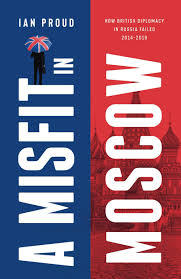
By Eamon Dyas
The author was a member of the United Kingdom Diplomatic Service between 1999 and 2023. In that capacity he was responsible for the organisation behind the 2013 G8 Summit which took place in Northern Ireland and which was the last occasion Vladimir Putin visited the United Kingdom. Having applied to work at the British Embassy in Moscow in June 2013 as the senior diplomat charged with increasing UK-Russian trade (at the time the UK had the largest foreign investment in Russia in the form of BP’s 19.7% investment in state oil giant Rosneft) he instead found himself between July 2014 and February 2019 acting as the senior adviser to the British Government on sanctions against Russia that began in the aftermath of the Russian annexation of Crimea. While at the Moscow embassy Proud was also chair of the Russia Crisis Committee, Director of the Diplomatic Academy for Eastern Europe and Central Asia and Vice-Chairman of the Board of the Anglo-American School of Moscow.
Ian Proud is therefore someone whose observations and insights into the events surrounding Britain’s relationship with Russia in the critical years 2014 to 2019 are worth considering. The first thing to note is that, as he himself says:
“This is not an academic book or a forensic picking apart of the UK’s activity in Russia; the limitations of the Official Secrets Act and the Radcliffe Rules would prevent that. I wrote this account entirely from memory, and from open-source research when I needed to check specific details or data.” (Preface, pp.ix-x).
Nonetheless, in compiling his memoir he was compelled to submit the manuscript to the Cabinet Office for their approval in order “not to unstitch the straitjacket of British government censorship.” As it was, he felt he was lucky to have got away with cuts of around four thousand words. The second thing to note is that the memoir is not published by a mainstream publisher but appears to have been self-published. This is in keeping with the way in which “inconvenient” information and perspectives on the Russo-Ukrainian conflict are kept as far as possible from public consumption not only by direct censorship by western states but by the media, and by the literary, educational, cultural and academic institutions of those states. This has meant that alternative interpretations of the Russo-Ukrainian crisis are systematically denied an outlet leaving the debating ground dominated by the establishment narrative.
Although he titles his memoir “A Misfit in Moscow” it would be a mistake to think that Ian Proud is some kind of disloyal servant of the British Foreign Office. He continues to follow the Foreign Office line in describing the Russian Special Military Operation of February 2022 as “a full-scale invasion” for instance. As the economic expert at the British Embassy in Moscow he played an important role in advising the British government on its anti-Russian sanctions and was one of the first to suggest placing a price cap on the price of Russian oil, all of which is testimony to his commitment to his employer. Nonetheless, he does possess an unusual characteristic among western diplomats in that he appears to have a genuine desire to describe events as he sees them and not always in the context of the Foreign Office perspective. This is something he is unapologetic for as he sees this as an essential component of any diplomat’s ability to provide proper advice to his or her government.
From the outset of his career in the Moscow embassy in 2014 Proud did not subscribe to the idea of a Russian threat to Europe. At the time he felt that;
“Russia is undoubtedly still a powerful country, but it is in secular decline. Its economy is about the size of South Korea’s, its workforce is shrinking, and life expectancy is around ten years lower than the OECD average. NATO is at least ten-times greater economically: it has three times more active military personnel five times more combat aircraft and four times the number of ships. And NATO has access to more modern and sophisticated weaponry across most systems.
“Putin isn’t bent on world domination nor the recreation of the Soviet Union. Of the fourteen other former-Soviet countries, Russia can only count on Belarus to act as a compliant buffer, although [it] retains significant influence in Moldova and Armenia. To its under-populated east, Russia is vastly overmatched by China, also ten-times larger economically, and progressively being overtaken by India.” (Preface, p.vii).
The view that Russia is a threat to Europe has been increasingly pumped out by western governments over the past ten years and it now constitutes the main position of most EU governments as well as the UK. Hardly a day goes by without some statement by a leading politician or military “expert” voicing the opinion that if Russia is allowed to achieve any kind of victory in Ukraine it will then have its sights on the Baltic countries and after that the rest of Europe. What Ian Proud’s continued testimony represents is a reminder of a recent time when more sober minds were allowed to put their case to government decision makers whereas now, the only voices that are heard are the siren voices of the Russophobic war-mongers.
The Skripol poisonings
The event which Proud comments upon in some detail in the prologue of the book is the Skripol poisonings in March 2018. Although he does not directly challenge what has come to be the official version of that event it is obvious that he is sceptical of the explanation that directly implicates the Russian State in those events. Instead he offers a wide arena of possibilities which includes a rogue state actor or a non-state actor such as a member of a Russian mafia group. He also provides an interesting explanation which involves the possibility of an element from another country that was eager to provoke a British backlash to the improving Russo-British relations that were emerging at this time.
Proud describes this improvement as follows:
“And while UK-Russia relations had been frostier than a Yakutsk winter since Russia’s annexation of Crimea there had been modest signs of improvement at the end of 2017. The press was reporting that, since his appointment as Foreign Secretary in the summer of 2016, an unstoppable Boris Johnson had been blocked from reaching out to Moscow by an immovable Prime Minister Theresa May. Tory party in-fighting and Theresa May’s hard line stance was leaving the UK increasingly isolated within the EU on Russia policy. With the Prime Minister’s authority dented by an ill-timed general election that left the Conservatives governing without an overall majority, I pressed on the need for higher levels of engagement.
“Slowly, Whitehall was beginning to move and in November 2017, junior FCO minister Sir Alan Duncan travelled to Moscow for the first ministerial visit to Russia in two years. He visited Moscow’s Luzhniki Stadium to see preparations for the 2018 football World Cup. He also sealed a new diplomatic visa deal between the UK and Russia after a twelve-month blockage which had left the Embassy in Moscow chronically short-staffed. Shortly afterwards, the Archbishop of Canterbury, Justin Welby, arrived in Moscow for a visit described as ‘pastoral, ecumenical and political.’ And then in December and at the third attempt, Boris Johnson paid the first Cabinet-level visit to Russia for five years for talks with his counterpart, Sergey Lavrov. . . .
After an almost four-year permachill in the relationship, this was a positive tidal wave of diplomatic engagement. So, against the backdrop of a slight thawing of relations, the ‘Kremlin did it’ thesis didn’t completely add up to me, although I didn’t discount Russian state involvement in some way.” (Prologue, pp.xv-xvi).
Nonetheless, given his earlier speculation about an agent from a country other than Russia being involved it is surprising that he doesn’t consider Ukraine as a candidate where the prospect of a growing post-Crimea thaw between Russia and Britain was certainly being viewed with alarm at the time.
The events of 2014
In preparation for his assignment to the Moscow Embassy Proud began a Diplomatic Service Russian language course in London in September 2013. One of his teachers was a woman named Veronika who came from Kyiv and the other a Cambridge educated linguist named Nadia who came from the city of Donetsk in eastern Ukraine. The duration of his Russian language course overlapped the events in Maidan Square between November 2013 and February 2014. Although those events took place over 1,500 miles away they assumed a closer reality in Proud’s Russian language classroom.
“This tension [the Maidan Square events – ED] played itself out for me daily in the classroom. Veronica started to bring in anti-Russian cartoons and poked fun at Putin, although it was clear she didn’t consider Russia’s behaviour funny. Nadia complained that the news coverage in the UK was lopsided and that surely Putin wasn’t that bad. They stopped talking directly and instead communicated through me. I was living in a microcosm of the Maidan Square arguments, without the violence.
“The other Russian teachers were often in huddles in the library area, split into distinct pro-EU and pro-Russia groups. They reflected the clear divide in Ukraine: in Kyiv and in the west of the country, the Ukrainian language is widely spoken; in the east and south, including Crimea, Russian is the lingua franca and large swathes of industry were tied into Russian supply chains. . . .
“Time and again I would hear colleagues either at the British embassy in Kyiv or at the FCO in London talking emotionally about Ukraine’s European ‘choice.’ But it was clear that not everyone in Ukraine saw Europe as their first or best option. The western media often depicts Ukraine as culturally and politically homogeneous, with a citizenry unified in its desire to sever all connections with Russia, but this is grossly inaccurate.” (p.24).
This is a view that has since become a “no-go” area in what passes for discussion about the Russo-Ukrainian conflict. In terms of the usurpation of the elected President Yanukovych Proud is quite frank in that the US Assistant Secretary of State, Victoria Nuland and the US ambassador to Ukraine, Geoffrey Pyatt, had been plotting to ensure that Yanukovych was deposed and replaced by a pro-western alternative and that “after Yanukovych’s removal, Nuland wanted Arseniy Yatsenyuk” as his replacement – a plot that had the endorsement of the then Vice-President, Joe Biden. Proud also explains that Yanukovych had, on 21 February, with the approval of the governments of Germany and Poland, agreed several concessions to the demands of the Maidan protesters and committed to hold presidential elections no later than December – the arrangement was known as the 21 February agreement. However, before he had the opportunity to implement this agreement an attempt on his life drove him out of the country on 22 February 2014. The day after, on 23 February, the Ukrainian Parliament passed a vote formally removing him from office despite the fact that the process was itself constitutionally flawed as it was done with “a vote tally that fell slightly short of that required under the impeachment provisions in Ukraine’s constitution.” On reflecting on these events Proud says:
“Had Yanukovych signed the association agreement [it was his refusal to sign the association agreement with the EU that triggered the protests – ED] and been ousted by pro-Russian extremists, it would have been condemned from the rooftops of the Berlaymont [the European Commission headquarters in Brussels – ED] and the Capitol. Instead, Western diplomats shrugged their shoulders when the 21 February agreement was binned.” (pp.25-26).
He then describes one of the first actions of the post-Maidan Ukrainian parliament as follows:
“Buoyed by anti-Russian sentiment, Ukraine’s Parliament cancelled a law giving regions of Ukraine the right to have a second official language. This meant that in places like Crimea and eastern Ukraine, Russian could not be recognised as an official second language, even though it was the language that most people used.” (p.26).
At this point it should be pointed out that the US-installed replacement Prime Minister, Arseniy Yatsenyuk, had four years earlier been one of the leaders of the violent protests against the Ukrainian Parliament’s endorsement of a new 25-year agreement to permit Russia to continue to use the Sevastopol Naval Base. At the time he had pledged to ensure that the agreement would be terminated at the first opportunity (see: “Agreement on Black Sea Fleet may be denounced”, Kyiv Post, 27 April 2010). In February 2014 that opportunity emerged for Yatsenyuk and this no doubt was one of the factors which, on 27 February 2014 – the same day that Yatsenyuk was installed as Prime Minister – led to the Russian government instructing its troops and naval forces stationed in Crimea to take control of the territory.
Proud later pointed to another example of Yatsenyuk’s hostility towards any accommodation with Russia. It relates to the $3 billion Eurobond which Ukraine had purchased from Russia in 2013 and which was due to be repaid in late 2015. With Ukraine experiencing a severe economic crisis in 2015 its international creditors had agreed to a debt restructuring deal which in some cases involved a write-down of 20% of debt owed as well as a revised repayment programme. Russia also made some concessions on the repayment of the $3 billion Eurobond arrangement with Ukraine now expected to make the repayment in three tranches of $1 billion between 2016 and 2018 but
“in the politically charged nature of the relationship, a deal could not be reached. Arseniy Yatsenyuk, America’s choice as Ukrainian Prime Minister, then declared a moratorium on repayment of the Russian bond.” (p.136).
Proud then reveals that in making this move Yatsenyuk was supported by Ukraine’s Finance Minister at the time, Natalie Jaresko and that Natalie Jaresko “was a former US State Department Official.” She had in fact been born and educated in the United States to Ukrainian parents and was therefore a US citizen. Although Proud does not provide this information, she only assumed her Ukrainian citizenship on the day in which she was appointed Ukrainian Minister of Finance on 2 December 2014.
On that same day the then President of Ukraine, Petro Poroshenko, signed a grant of Ukrainian citizenship for two other non-Ukrainians in order to facilitate their appointment to the Ukrainian cabinet. Those were, the US educated Georgian citizen, Alexander Kvitashvili who was appointed Ukrainian Minister of Health and the US educated Lithuanian citizen Aivaras Abromavicius who was appointed Ukrainian Minister of Trade and Development. Abromavicius was one of the supporters of Zelensky before he was elected President and was subsequently appointed by him as Director General of Ukroboronprom which is the largest arms manufacturer in Ukraine. He held that position until October 2020 and he is an enthusiastic advocate of austerity and a proponent of deregulation and privatisation. For the above information see: https://en.interfax.com.ua/news/general/237464.html
The condition of the British diplomatic mission in Russia
Proud is particularly critical of the culture that operated within the British embassy in Moscow during the time he was there. He traces the decline in the standards of British diplomacy generally to the decision by New Labour in the 1990s to abolish the Foreign Office Language School at Millbank where diplomats used to be provided with a first-rate instruction in the languages of the country to which they were to be posted. That action he said “sent an unhelpful signal that monoglot Britain didn’t see foreign language use as a vital component of diplomacy”. As far as Blair’s New Labour was responsible for this he says:
“The dumbing down of diplomacy started under New Labour seduced by the notion that modern diplomats needed little more than a laptop. Language skills? Look them up online. . . . But diplomacy is primarily a people business. While there used to be political courses in the Foreign Office, these were nixed in the noughties.
“This generational disinvestment in skills results in diplomats in Moscow sending regurgitated press insight to ministers through the medium of Google Translate.” (pp.72-73).
And today this tendency to “regurgitate press insight” is more prevalent than ever and not only through diplomatic channels. Hardly an hour passes than the British press will be uncritically passing as truth whatever the Kyiv regime’s propaganda department issues as a press statement.
Proud credits William Hague as the Foreign Secretary who attempted to rebuild British diplomacy as an important component of foreign policy in the aftermath of New Labour’s slash and burn policy. It was under his tenure as Foreign Secretary (2010-2014) that a new diplomatic service language school was established in the basement of the Foreign Office in King Charles Street and Proud was one of its first students. In terms of the continuing relationship between the British diplomatic service and the Russian language Proud also notes that
“The Foreign Office has improved its performance in language learning since 2010. But even today, [2023 – ED] over a third of British diplomats paid full-time to learn Russian for fourteen months either fail their exams, or worse still, don’t get around to sitting them.” (Note 8 at bottom of p.22).
As already noted, Proud successfully completed his Russian course and arrived at the British Embassy in Moscow in July 2014 at the same time as William Hague resigned as Foreign Secretary. Proud is sceptical of the reasons given by David Cameron for Hague leaving the Foreign Office which was to pursue “other interests”. But according to Proud:
“it wasn’t clear why a grandee of the Conservative Party would step down from his office of state ten months before the next general election. Rumour swirled that he’d fallen on his sword for Cameron’s twin failures on Junker [Cameron’s government had unsuccessfully opposed his election as President of the European Commission – ED] and Ukraine policy.”
“Hague was the best Foreign Secretary during my career. He arrived at the Foreign Office after thirteen years of New Labour disinvestment in diplomacy, and breathed life and purpose back into the organisation. A political titan he was replaced by “spreadsheet Phil” Hammond, who I hoped would be a short-lived stopgap.” (p.30).
As it was, Phillip Hammond remained as head of the Foreign Office for two years until July 2016 when he was replaced by Boris Johnson. In the meantime, Proud admits that the UK was providing military training to the Ukraine army in February 2015 in the context of the conflict in the Donbass region. This was three years before Trump began supplying Javelin anti-tank weapons to Ukraine in March 2018 (see note 14 at bottom of p.33).
There is also an interesting insight into the mind-set of the British Foreign Office during Tony Blair’s government.
“In 2000, a modern [British] Embassy, composed of four metal and glass blocks, was opened on Smolenskaya Embankment. It’s a stone’s throw from the White House [which was the seat of the Russian government in Moscow – ED], where President Yeltsin famously climbed on a tank in 1991 as an act of defiance against the attempted military coup. The materials and labour for the new building were trucked into Russia via Finland. Every dollop of cement was scrutinised, to prevent the introduction of listening devices and other sneaky tech. Steam billowed from the site during the winter, as heaters dried the foundations.” (p.34).
It would appear that the British retained the Cold War paranoia towards Russia at the time despite the fact that the West’s favourite, Boris Yeltsin, was Prime Minister of Russia during the construction of the British Embassy. Of course, it never occurred to the paranoid British that if the Russians suffered from the same condition they would have insisted on a close inspection of the imported materials in order to ensure that the British were not importing spying devices.
While working at the Moscow embassy he found that his colleagues were more interested in impressing the Ambassador, Tim Barrow, than in actually providing any real information or insights into the situation in Russia. In the context of the following quote from Proud, the term Chancery in an embassy context refers to the group of officers who are assigned mainly to traditional diplomacy, providing reports, and informing Ministers at home of foreign policy development in a particular country.
“Some described the Foreign Office as a group of over-achievers struggling to get along. The one-upmanship and chest-thumping hubris of the Chancery meeting typified this. It would have felt a better use of time if Chancery colleagues gained their insight by time outside of the Embassy, meeting Russian contacts in Moscow and further afield.
“In fact, much of the insight was drawn from unclassified media or from diplomats in other Western embassies. It was in this august setting, nine years ago, that I first heard the rumour that Putin’s occasional disappearance from public view might be related to a mysterious and terrible illness that could kill him within days.” (pp.35-36).
The story of Putin’s health is one that the western media spent hundreds of column inches on during the early years of the current conflict. Proud further explains the way the Moscow embassy gathered its information about what was happening in Russia. The result of this, according to Proud, was:
“The total collapse in the UK relationship with Russia – and related to that, the gradual and dangerous escalation of the Ukrainian crisis – has in part been caused by a statesmanship vacuum in the UK; successive members of the current government have actively chosen not to talk to Russia when tensions were at their highest.” (p.17).
Of course, all of this is based on the perspective of the diplomat who sees every conflict as solvable through diplomacy. The limitations of this perspective is that it finds it difficult to accommodate the idea that there was hostile intent from the outset when it comes to their own government. And even if hostile intent is admitted there is always the option of believing that their own government was acting either consciously or unconsciously under the influence of a more powerful ally.
We can see this blame shift operating in Proud’s own account of the way another part of the West’s narrative on Russia began to play out. That narrative was that Russia was always intent on using its position as the dominant supplier of energy to Europe for its own political, rather than financial, ends. However, as Proud admits:
“Cutting oil and gas exports to Europe would be like playing Russian roulette with a fully loaded gun; there is no evidence that Russia has ever sought to cut energy supplies to Europe to serve a wider political goal.” (p.45).
And further:
“In reality, Russia needs to export its gas, in part to subsidise domestic consumption at discounted rates, a hangover from the Soviet days. For a Russian economy that has struggled to diversify, gas exports provide a significance source of foreign reserves and domestic tax receipts. At that time cutting off gas supplies to Europe would have represented a nuclear option with massive economic costs to Russia itself. And there was practically no evidence that Russia wanted this.” (p.48).
And yet, despite this opinion from the man whom the British government itself sent to Moscow with the purpose of providing it with an ongoing analysis of the economic situation in Russia, the British government continued to insist that the object behind Russia’s export of oil and gas to Europe was a sinister one. But according to Proud it did this in order to comply with the US policy of opposing Russia’s Nord Stream II project (see p.49). According to Proud the foolish nature of this commitment to the US was to contribute to a breakdown in diplomacy and that was taking the UK on a very dangerous trajectory.
“In those early days of my posting I considered that a more open economic relationship with Russia had a greater chance of earning peace than chest-thumping political posturing. Ministers and colleagues in London invariably saw it from the other end of the telescope: that Russia needed to make political concessions after the start of the Ukrainian crisis, that approach has simply inflamed resentment and prompted increasing dangerous tactics by Russia in response. The risk that our political leaders, unable or unwilling to engage in dialogue, will allow us to sleepwalk into the devastation of war with Russia appears greater than ever.” (pp.52-53).
So even though he acknowledges that the behaviour of the British government was based on a definition of Russian intent that ran counter to his on-the-spot understanding of what Russia was about he cannot quite bring himself to confront he possibility that this was something that was consistent with a deliberate British strategy of provoking and then isolating Russia. It is far more comfortable to rely on the old standard that Britain was “sleepwalking” into a possible war with Russia in a similar way that some historians still believe that Britain “sleepwalked” into its war with Germany in 1914.
How capitalism was made to work in Russia
As an economic analyst Proud’s account of how capitalism was made operational in Russia is also interesting.
“After the Soviet Union collapsed, there were no rules or legal framework to manage the bone-crunching transition from communism to a mixed-market economy. Lawlessness ruled across the Russian Federation, and commercial disputes were more often settled by shoot-out than by subpoena. Within this deadly legal vacuum, some smart-minded Russians conjured up schemes to get rich quick: they monetised the Soviet system of credits to grab hundreds of millions of dollars out of thin air, bought up privatisation vouchers from clueless citizens and conned those citizens with pyramid schemes that always collapsed. Vast profits were used to buy ever-larger stakes in Russia’s lucrative oil, gas and mineral companies. Surfing this raging torrent of venality were the new oligarchs, who became multi-millionaires almost overnight. After Russia’s default in 1998, the oligarchs emerged triumphant as billionaires at the summit of Russia’s industrial complex, lifted up by shady loans-for-shares deals with the ailing Yeltsin.” (Proud, p.60).
In his notes to the bottom of the page Proud provides further details:
“Soviet industry was funded by a system of credits through which one factory could obtain goods and services from another without the need for cash transactions. No money changed hands. Mikhail Khodorkovsky persuaded foreign banks to recognise credits managed by his bank on behalf of the Russian Finance Ministry as hard currency.” (Note 31, p.60).
“In the early nineties thousands of state-owned enterprises in Russia were privatised by the mass issuance of vouchers to every Russian citizen. Each voucher wasn’t worth much and as most people didn’t understand what to do with them anyway, they practically gave them away in the millions for inconsequential amounts.” (Note 32, p.60).
In the light of the role of the foreign banks in this arrangement it is hard to be convinced by Proud’s eagerness to dispute any charge of Western culpability in the resultant expansion of the corruption and chaos.
The Minsk agreements – how Britain encouraged Ukrainian sabotage
In his account of the Minsk agreements Proud acknowledges that “it was clear that Ukraine would not follow through with this provision” [the one which required the decentralisation of the Luhansk and Donetsk regions of the country – ED]. Nonetheless, he claims that “Russia made little attempt to hold up its end of the bargain either.” (p.88). It is hard to see how Russia could be expected to do so if Kyiv refused to implement the constitutional changes required to enable Luhansk and Donetsk to function as decentralised regions within Ukraine as whatever Russia had been obligated to do was conditional on that core action being first taken by Ukraine.
Proud does point out the way in which the depiction of Russia as the culprit in 2014 played into the hands of the anti-Russian element in British politics. And he does acknowledge that the British position of insisting that there be no relief from sanctions against Russia unless the Minsk agreement was implemented in full provided an incentive for Ukraine to sabotage the Minsk agreement as, under British policy, Ukraine was not being held to a similar responsibility by the UK government:
“Minsk implementation was described in binary terms; it either was or was not implemented in full. This might make sense on a tightly edited Foreign Office draft strategy in King Charles Street. However, it was unrealistic in a complex insurgency with state and non-state forces fighting on both sides of a line of contract that stretched for hundreds of miles.
“De facto, Minsk conditionality would give Ukraine the casting vote; inaction on their part would lock in sanctions against Russia, so why would they engage with the separatists in the Donbass? (p.89).
Kyiv’s attitude towards Minsk was revealed in the most basic of levels with its refusal to implement one of the simplest requirements of the agreement, which was that it open negotiations with the representatives of the dissenting regions of Luhansk and Donesk.
The British government was well aware that its policy on Minsk provided an incentive for Kyiv to refuse to implement its side of the agreement and having established its use in that regard it then “started to push EU Member States to support this approach.” (p.90). And the decision taken by the European Council in March 2015 to link the duration of the sanctions against Russia to the “full implementation of the Minsk Agreements” meant that “The UK government had succeeded in its efforts to insert this conditionality into EU-wide sanctions policy towards Russia.” (p.124).
Surprisingly, or not surprisingly depending on your assessment of Proud, he does not mention the revelations by Merkel and Holland which show that the whole Minsk thing was a charade put in place in order to provide time for Ukraine to improve its military capability.
Russia and the Greek crisis of 2015
In his capacity as the economic expert at the British embassy Proud attended the St. Petersburg International Economic Forum in June 2015. It was a meeting at which Alexis Tsipras, the Greek Prime Minister, was also a speaker and whose country was in the middle of a debt crisis at the time. The global financial crisis of 2008 had a particularly hard impact on Greece and revealed the country’s lack of competitiveness and exposed the government’s lax fiscal policy. In response to requests for help in 2010 and 2012 Greece had received bailouts from the Eurozone and the IMF to the tune of 216 billion euros. But by 2014 with the government having failed to fully implement the austerity measures and market reforms that were a condition of these bailouts the second aid programme was held in abeyance. As a result of a snap election held in January 2015 the hard-left Syriza party was elected on the basis of a commitment by Tsipras to end austerity and stand up to the Eurozone.
“By mid-June negotiations with the European Central Bank and Eurozone Finance Ministers were gridlocked, meaning Greece was staring down the barrel of a sovereign default. The other looming deadline was the rollover of European sanctions against Russia.
“And therein lay the reason for Tsipras’s visit to Russia. During a visit to Moscow two months previously, he had said that his government ‘openly disapproved of sanctions.’ (p.125).
According to Proud after the election of Syriza in January the British government had been gravely concerned about the prospect of Greece breaking the European consensus on sanctions as the existing period of their application was due to expire in March 2015 and required unanimity by all twenty-eight members for them to be rolled over. As a result of that concern “Senior British diplomats shuttled around the EU lobbying their counterparts to hold the sanctions line and to encourage the Greeks to do so too.”
That then was the political context in which Tsipras took to the stage at the St. Petersburg International Economic Forum in June 2015. Proud describes what followed:
“He shook Putin’s hand on the way to the podium before commenting to the audience, ‘You are probably wondering why I am here,’ as if it wasn’t blindingly obvious.
“Tsipras offered a rambling and indescribably pompous speech in which he spoke of Greece’s problem being Europe’s problem, and how Greece could help build bridges between Russia and Europe. He offered a vague mention of Minsk and avoided the more direct criticism of sanctions that he’d made during his April visit. The video feed panned to Russian ministers like Sergey Lavrov making eyes and joking with each other as if to say, ‘What the fuck is this all about?’ When his fifteen-minute speech finished, Tsipras turned on his heel and strode off the stage without acknowledging anyone, including a bemused-looking Putin.” (p.126).
Proud offered his explanation for Tsipras’s behaviour:
“With the renewal of Russia sanctions on the immediate horizon, Tsipras was clearly playing the Eurozone to drive progress in negotiations on a third bailout package. The benefits of taking a sticking plaster pay-out from Putin were, I suspect, far outweighed by the risks to Greece’s economy of burning bridges with the EU. While Greece defaulted on a small IMF payment at the end of June, a third Eurozone bailout package was nonetheless agreed on 12 July 2015 worth Euro86 billion.
“Three days after Tsipras’s visit on 22 June 2015, EU sanctions against Russia were extended; from that moment, they were effectively set in stone.” (pp.128-129).
In other words, Tsipras was using the threat of blocking the EU Russia sanctions as the means of acquiring a third bailout from the Eurozone. His public appearance in Russia was meant to provide credence to that threat with the implication that if no EU bailout was forthcoming he would apply to Russia for help. As it turned out, Putin, presumably eager not to antagonise the EU at a time when it was about to ratify the next rollover of sanctions and in the hope that a refusal (or an offer to help Greece that was so small it could not come anywhere near what Greece needed) would show the EU that Russia was not its enemy.
The diplomat’s perspective
When we look at how Victoria Nuland and the US Ambassador to Ukraine, Geoffrey Pyatt behaved in Kiev in 2014 and how the US Ambassador to Syria, Robert Ford, behaved in the Syrian city of Hama in 2011 and we compare it with how the British diplomat, Ian Proud behaved during his tenure in Moscow there is a world of difference. However, it would be a mistake to believe that one is somehow superior to the other. They all serve their country in the circumstances in which they find themselves. From the British perspective the difference would be explained by the fact that British diplomats are picked from a cadre of professional civil servants educated and trained specifically in the arts of diplomacy. But, as we have seen in Proud’s own experience, that would appear to be something that is currently being eroded. The US diplomat is more often someone who is appointed not from within a cadre of professional diplomats but rather a political appointment that is framed by considerations of election donations and/or for specific skills assumed outside the world of diplomacy. From the US perspective, they would see the difference as something that emanates from the fact that the US diplomat is the representative of the most powerful country on the planet and is therefore charged with ensuring that his/her country’s interest are always first and foremost in what they do whereas the British diplomat represents a second-rate power with the luxury of being able to lay more emphasis on procedure and ceremony than the hard reality of realpolitik.
In the case of Ian Proud, for the above reason, British diplomacy can afford to indulge some levels of eccentric behaviour which can lead to a public display of differences in perspective from that of his government. However, as stated earlier, Ian Proud remains very much a servant of HM government and this is shown by the manner in which even his honest observations of what was happening in Moscow between 2014 and 2019 do not allow him to depart from his government’s basic line on Russia in the context of the Ukraine conflict.
Despite all the evidence of how the legitimate President of Ukraine was illegally overthrown in 2014 with US support and how Russia was duped and unfairly treated over Minsk, and the provocations that were thrown at Russia by successive post-2014 Ukrainian governments and the West as well as the threat posed by NATO, Proud, as servant of HM government cannot quite bring himself to dissent from the main line of his government. In direct contradiction to his acknowledgment of all that he witnessed he can still describe Russia’s actions as a “mindless and needless invasion of Ukraine” and its initiation of an “unconscionable and, in my view, avoidable war”.
But he cannot quite dismiss the impact of all of the evidence he has borne witness to so he seeks a reason that remains consistent with the facts. He chooses to find that reason in the world of diplomacy – or rather a failure of his government to invest enough in diplomacy. He then asks three questions that all emanate from his chosen reason:
“I ask three questions: was the Tory foreign policy non-engagement with Russia the right approach; is the Foreign Office equipped with the right skills to engage with and understand Russia, and therefore advise ministers well; have Western sanctions materially altered Russia’s posture towards Ukraine and made conflict less likely?’ (p.269).
There is an innate presupposition operating here and one in which the world of diplomacy can never alter. That is, a presumption that the British government did not have any desire to damage Russia. But it is something that Proud cannot admit as to do so would mean that there are some instances where all the diplomatic skills in the world are of little use except to create a false impression that the country in question does not possess such ill intent. It is this perspective which creates the fallacy of the “sleepwalking to war” scenario that Proud himself subscribes to when he says on page 53 that a failure to engage in diplomatic dialogue by Britain “will allow us to sleepwalk into the devastation of war with Russia”.
But despite his honest appraisal of the failure of Britain’s commitment to a proper diplomatic relationship with Russia, Proud has remained committed to his government precisely because he views the current state of affairs as a failure of diplomacy rather than a deliberate policy designed to inflict harm on Russia. In the epilogue to the book, Proud says that he was:
“wheeled out of retirement in early 2022 to authorise a significant chunk of sanctions against Russia after the invasion of Ukraine.” (p.272).
And it says something for his commitment to his government that he admits he did this even though he had seen the futility of sanctions when they were applied in 2014, as mentioned earlier in the book:
“we hit diminishing marginal returns on sanctions within the first couple of weeks after war started. Every sanction since then has been a sticking plaster on feelings of inadequacy that we can never give Ukraine quite enough weapons to beat Russia, and that we would sooner not send our own troops. As a result, Russia and Ukraine have fought each other to a bloody standstill, like the Somme. Neither the UK nor the US are promoting the idea of a ceasefire, to allow a (frankly) decades-long peace process to recommence. Nine years on from the onset of conflict, we remain convinced our strategy is working!” (p.272).
One wonders why he should help to continue to contribute to a destructive war in this way when he is aware of the futility of what he is doing. And nobody familiar with the conflict would say that “Russia and Ukraine have fought each other to a bloody standstill, like the Somme”. On that Proud is incorrect. A simple check of the map of the front line would show that Russian forces continue to make daily incremental gains in terms of territory. Also, events have moved on with regards to calls for a ceasefire but there is little likelihood of Russia agreeing to such a ceasefire while the west remains committed to continuing the supply of arms to Kyiv.
Overall, Ian Proud has produced a useful insight into the interplay of British diplomacy in Moscow with the government in Whitehall at a critical period in Anglo-Russian relations. However, because of the world in which his perspective has been formed it lacks a clarity of explanation that would have made it a far more important book. On a practical note, the absence of an index is a real drawback to the use of the book as a reference tool.
 Labour Affairs