Catherine Dunlop
“People want to be governed.” This is what Burke said and it’s a fundamental truth. People want to get on with their lives and they rely on a government to maintain an environment where they can get on with their lives.
The instrument of the government is the state; a modern state has a police to maintain order, an army, an education system, infrastructure etc; it has a gold reserve and it issues currency and levies taxes (in XVIIth century England there were great tussles as to how much of this treasure the king was allowed to have.) More on the state issuing currency below. All this is managed by legislation.
The population is made up of groups which may or may not have the same interests.
Take England in the 1920s at the time when Ernest Bevin was trying to organise a general trade union. The mine owners and the factory owners stood on one side of the fence and the workers, employed or unemployed, on the other. The employers had the power to impose low wages and long hours, and in the case of dockers, no contract of employment, so men were employed by the day or the half-day. Employers maximised profit by extracting the maximum work for the lowest pay. The achievement of Bevin was to redress the balance of power between employers and men through union organisation. He encountered resistance not just from the employers and the government, but also from the men themselves, who in some cases already had a small union and didn’t want to relinquish what they had. He also encountered resistance from the Communist Party which wanted revolution not bargaining power.
Through the work of Bevin’s Transport and General Workers Union, and its weapons, that is, strikes and threat of strike, as well as Bevin’s negotiating talents, hours shortened and wages increased.
What is the stance of the government in this struggle? Does it side with the employers or the men? It follows its rule, that the population should feel it is able to get on with life. If there is discontent, the reaction of the government will depend on the influence the discontented group has. If it has no influence, the government will do nothing. The government will do what the strongest group in society wants.
Members of the government at the time were friends and relations of the employer class. They formed the English ruling class, united by wealth, tradition and education and not disunited by strong religious feelings (the Church of England is a broad church), or by competing political ideas since the power of the king was tamed in 1688.
This is what Bevin was up against in the 1920s. Class differentiation was clear: the employer class owned assets and were entitled to respect, the working class was the opposite.
Then in the 1930s the great depression threw millions out of work. Unemployment then meant no money and no food. The ruling class split. Some wanted to sit it out and wait for better times. Keynes thought that unemployment was too bad to do nothing about; his revolutionary thought was that the government should step in and provide employment; he said: “Anything we can actually do we can afford.”
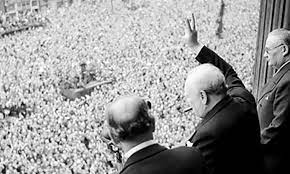
This was revolutionary, since under free capitalism it is private enterprise that provides employment. The idea however came not from the trade unions but from a member of the ruling class. Keynes and Bevin worked together on committees, but it is Keynes who wrote the books and is remembered. Bevin ran the economy during the war, and he stood next to Churchill on the balcony of Buckingham Palace on the 8th May 1945. (See photo). He is a true working class hero who never betrayed his class.
After the war, thanks in part to Bevin, the balance of power had changed in favour of the working class; the state took on functions that did not favour the employer class, by nationalising transport and industry. The welfare state and a national health system were introduced. Unions got more power.
The employer class has been working ever since to redress the balance of power in its favour and it succeeded, most remarkably with Thatcher and her successors. State assets were sold off, and as much as possible was given over to the private sector. Eventually even vital institutions like schools are being given over to private companies funded by the state.
Thatcher and her successors had little or no opposition to their schemes, partly because they gave compensations: People were no longer discouraged from claiming benefits; they got to own their council flats and houses through generous discounts; the use of credit was generalised, all creating an impression of ease.
Large numbers of industrial jobs, from the shop floor to technicians to engineers and scientists, simply disappeared.
The economy changed: out went industry, in came services and large shopping malls. Class distinctions blurred. Working class people owned their own homes, acquired a credit card, went on foreign holidays. Cameron interviewed on television was expected to answer questions on the price of a loaf of bread, as if he did the shopping like everyone else.
The result of that new economy is that the rich have become hugely richer and the poor hugely poorer and the gap between the two wider.
In the 1970s the gap between the lowest and the highest paid was much smaller than now; the gap in asset ownership is even wider. The number of private jets and super yachts has seen a fantastic increase, ironically since 2015 and the Paris Agreements on Climate Change.
The paradox is that the Labour Party Manifesto piously puts its propositions within the frame of the UK’s legal obligations regarding Climate Agreements, while presiding over a system that permits or even encourages conspicuous consumption of energy hungry luxury goods.
The other paradox is that when there was relative equality, the class struggle was at its height, whereas now that inequalities are glaring, there is no feeling of class among the population and no struggle, apart from sporadic actions for wages. Of course that is not a real paradox: the super-rich get away with it because there is no opposition to speak of.
The discontent from the poorest is not expressed, since the poorest have no access to the media and are powerless. Expressions of discontent come from those who have access to the media, the middle class; they are put out by the worsening of conditions in the NHS: longer to wait for an appointment, GP consultations reduced to a maximum of 10 minutes, sometimes just a phone call. They are disgusted by the private water companies pouring sewage into rivers and lakes.
The question is, where is the balance of power? Which group can cause enough pressure to force the government to act in their favour?
There is much discussion, and not just among bloggers and podcast makers, around the idea that the government could, at no cost to the ruling class or to anyone, issue money to spend, for example on the NHS and on nationalising the water industry. In fact this idea (sometimes called Modern Monetary Theory, MMT) is so prominent that the Bank of England has issued a paperback entitled “Can’t we just print more money?”. (It answers “yes, but there are limits”. It doesn’t elaborate on the limits).
The political limit to money creation is the balance of power between the different groups in society; the dominant group being the ruling class, or the class of employers, who want a maximum of economic activity to be in private hands, their hands.
A campaigning group, We Own It, claim that 80% of the population want water renationalised. But what are the incentives for the government to renationalise? The pressure from the private sector is stronger than public opinion, and that’s that for the moment.
What are the other limits on printing money? The public was made aware of Quantitative Easing, money creating, during the financial crash of 2007, and during Covid. 2007/8 was a very dangerous moment for capitalism. It laid bare the fact that the state is the source of money and that the state was absolutely essential to the very survival of private banks; and it opened the way for the question to be asked: if the state can spend on rescuing the banks with no bad consequences, why can’t it spend to nationalise water and pay nurses better? It was crucial for the ruling class to come up with a convincing answer. It was a golden opportunity for other groups to open their eyes and to open the eyes of the public to the fact that government spending is a political option. The opportunity was totally missed.
The real answer that the capitalists said to themselves is, the state can’t create money because we don’t want the government to exercise its power to spend.
Obviously this can’t be said out loud. So the story is put about that state finance is like household finance: expenditure should not be bigger than income, and because the state has spent enormous amounts in a time of crisis, it must now reduce spending, make cuts and impose ‘austerity’. It is a simple common sense story that persuaded people, already shaken by the crisis, and who instinctively feel that there must be limits somewhere to money creation. Whether some government ministers actually believe the household budget story does not matter, whether they believe it or not, the pressure is on them to behave as if it was true.
The household budget story and austerity are two sides of the same coin, or the same lie.
The main reason that we won’t get the state to build more hospitals or renationalise water is that the ruling class don’t want it to do so. To put it crudely, the CEOs of the several private companies that run water in England are paid millions, and they cling to their yacht and private jet with all their energy, with the help of their friends in the same situation.
But suppose that the balance of power changed and a party with the interests of the working population in mind came to power. There would still be limits to money creation.
One of the MMT bloggers, Richard Murphy, explained the limits in one of his videos.
“Let’s look at what modern monetary theory says: it is necessary to have a properly functioning economy which runs its own currency because it’s really important to understand those conditions because when they don’t apply, of course modern monetary theory doesn’t apply either.
And those conditions are that the government in question must be strong. In other words, it must have popular support.
It must be upheld by the rule of law.
It must be respected.
It must also have its own central bank or, in the case of the Eurozone, be an active participant in a currency zone where there is a strong central bank.
It must be able to operate an efficient tax system because if it doesn’t have such a tax system, it can’t recover the money from the economy that it has spent.
It must have a sufficiently large government sector that the government’s demand to be paid, in the form of taxation, basically forces the currency that the government creates into use in that economy for everyday exchange. If there are parallel currencies operating in a country, it’s very difficult to enforce any form of monetary policy.
The currency in question must also be acceptable for international trade. That’s vital because if it isn’t accepted for international trade, then the country is wholly dependent upon its ability to make export sales, to buy the currency that it requires, to pay for its imports, whereas if the currency is available and acceptable for international trade, then it can effectively trade internationally on credit. And that allows it to, therefore, ride out the inevitable troughs and highs that exist with regard to the economic fortunes of any country.
And perhaps finally, and very significantly, there must be no sanctions against trade with that country and no bars on the use of its currency, and it mustn’t be the victim of war or some other deep political circumstance that means it’s basically a pariah within the international community.”
(From his blog ‘Funding the future’)
England does not exist in a vacuum. It is part of an economic and political bloc consisting of the US and the EU. Both have a strong policy that the state will not spend to create wealth, because wealth should stay with the private sector. What would their reaction be if England started breaking ranks and going back to an economically creative state? They could easily sabotage England by various means, e.g. by demanding to be paid in Euros or Dollar for goods imported into Britain.
The reason the state will not create money for public goods is that the employer class don’t want them to. And conversely, the employee class is not making a strong and coherent case that creating money would be good for the country’s economy as a whole, as part of a system. Creating money, yes, but what for? What will it lead to? It will lead back to the post war situation, and that is (probably wrongly) not a popular option.
Richard Murphy agrees that the choice is political and a result of the balance of power:
“So the choice is, the City and the wealthy versus the people. It is becoming increasingly clear that is the case. The massive, panicked and utterly absurd reactions to Labour’s feeble attempts to adopt a different agenda makes clear that is true.
Rachel Reeves could decide to be on the side of the people.
It is already clear that she is caving in on almost all her plans. She is deciding to succumb to the demands of the City and wealth.
The short-term cost will be enormous. Misery and despair will continue whilst the wealthy continue to consume our planet as if there is a spare available when this one runs out, which will never be true.
The long-term costs of this cowardice from Reeves will be bigger still: we are talking about the fates of people, this country, our democracy and our planet here and she is putting herself on the wrong side of all of these issues.
Meanwhile, the IFS is hailed as the voice of reason when it is the voice of the wealthy and the City, wishing, as a result, the destruction of everything of value in our society.”
Richard Murphy is right in what he says, but he is not framing his demand for state spending within the framework of a system. He seems to think that the system is OK, but would be improved with more state spending. He does not see that more state spending means a change in the balance of power, that is, a change in the economic and political system, a return to 1945.
It seems paradoxical that at a time of extreme wealth inequality, there is so little consciousness of injustice. But the dominant view is put about that ‘we are all in it together’; the financial crisis put us all in danger; the Covid crisis put us all in danger; the climate crisis puts us all in danger.
People are encouraged to believe that the British people stand together and have always been ‘a force for good in the world’ ‘standing alone’ to save the world from Hitler (never mind from Napoleon) and now Putin.
There is ‘the cost-of-living crisis’ but even that, the government is pretending it is trying to solve on behalf of the whole population. The influence of the super-rich is everywhere and they are not unpopular yet, despite eating up the earth’s resources and denying many people a decent standard of living, timely medical care and clean rivers. But the pendulum will turn, when people feel that they are not being governed properly.
 Labour Affairs