LABOUR OUTLINES INDUSTRIAL PLAN
Unions welcome opportunity to reshape Britain – if money forthcoming
LABOUR’S new industrial strategy is a “golden opportunity” to transform the economy but must have real money behind it, unions said yesterday. [14 October]
The government published a green paper opening a consultation process on its 10-year plan at its inaugural International Investment Summit.
Business and Trade Secretary Jonathan Reynolds said: “Our modern industrial strategy will hardwire stability for investors and give them the confidence to plan not just for the next year, but for the next 10 years and beyond.”
The strategy is due to be published in the Spring Spending Review and will focus on eight “growth-driving” sectors: advanced manufacturing, clean energy industries, creative industries, defence, digital and technologies, financial services, life sciences, and professional and business services.
Firms, business experts and unions have until November 24 to provide feedback.
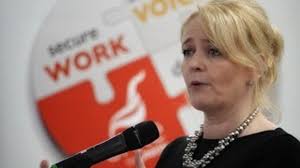
Unite general secretary Sharon Graham said the launch of the green paper marked “an important step forward.”
She said: “An effective industrial strategy is essential if the UK is to meet its growth targets and create the jobs of the future.
“The failure of the previous government to establish a strategy was a gross dereliction of duty. As a result, investment in the UK now lags far behind the rest of the G7.
“An industrial strategy must be more than just warm words, it must have real money behind it, linked to skills and job guarantees.
“And it must be backed up by action.
“The errors of the past where companies received blank cheques with no job guarantees must not be repeated.
“At the strategy’s core, it must ensure that our move to net zero is not a jobless transition, creating working-class wastelands.
“The industrial strategy is a golden opportunity to transform our economic landscape and to ensure that the UK leads a new industrial revolution. Labour must grasp that nettle.”
TUC general secretary Paul Nowak said the chaos and confusion caused by previous Tory governments has led to “havoc for our economy and left us falling behind” as the US and European countries push forward with their own industrial plans.
“With this industrial strategy, the government has a chance to press the accelerator, with faster growth in key sectors to give Britain independent energy, clean industry, and world-leading technology,” he added.
“It is right that jobs will now be at the heart of the strategy — as the government set out, success will mean high-quality, well-paid employment across the country, backed by decent treatment for people at work.”
Prospect general secretary Mike Clancy said: “It is high time the UK had a proper industrial strategy bringing together government, business, trade unions and other stakeholders to address the UK’s urgent need to boost investment and innovation, improve growth and meet pressing societal and environmental challenges.
“Trade unions have a central and indispensable part to play in this. The economy’s and individual employers’ successes are in the interests of the UK workforce, which is why Prospect always seeks to work in partnership with employers and employer bodies to strengthen the businesses and industries we work in.
“From defence manufacturing and clean energy to tech and the creative sector, partnership is vital to progress,” he argued.
Institute for Public Policy Research (IPPR) associate director for economic policy Dr George Dibb said securing long-term, green growth for the economy “requires a strategic role for the state, actively shaping markets and working in partnership with businesses.
“Adopting a clear-sighted industrial strategy is all the more important as the US and EU have outflanked the UK in developing their own strategies to deliver green growth.”
bernytorre@peoples-press.com
Star Comment:
Labour’s industrial strategy and the pitfalls of private-sector ‘investment’
THE row over Transport Secretary Louise Haigh’s criticism of P&O ferries illustrates the contradiction overshadowing the government’s global investment summit.
Keir Starmer grovelled before P&O’s owner, DP World, after Haigh said she boycotted the ferry company.
Her rebuke was if anything mild. P&O not only illegally fired 800 workers in 2022, replacing them with staff paid less for longer hours; its CEO, Peter Hebblethwaite, admitted in Parliament that he had knowingly broken the law and would do so again.
He got away with it: receiving a £183,000 bonus on top of his £325,000 salary after the mass sacking. He remains in post today.
DP World was subsequently awarded the contract to run the Thames freeport in Essex; it threatened to withhold its £1 billion investment after Haigh’s rebuke, unfreezing it only after urgent “clarification” from No 10.
P&O is a “rogue operator,” as Haigh says, but the problem applies to all the transnationals Labour is trying to woo. On what terms will they invest in Britain, and is the price of their doing so our connivance at breaches of workers’ rights, environmental or safety standards, or indeed shameless profiteering at our expense?
It would be naive to imagine the interests of ordinary people are identical to those of the globe-spanning banks and private equity firms cheering on Starmer’s promise to “rip out bureaucracy” to unleash growth.
Goldman Sachs, whose CEO David Solomon is among those endorsing Labour’s plans, was fined over $5 billion in the United States for its role in the bankers’ crash of 2007-8 — when it made huge profits through betting on the failure of investments, an example of its own interests being diametrically opposed to the public’s.
Australia’s Macquarie has pitched £20bn in investments in offshore wind and an electric car charging network.
But Macquarie’s record of investment in British infrastructure is not encouraging. It bought a 48 per cent stake in Thames Water in 2006, which it sold in 2017 after extracting £879 million in dividends while Thames’ debt nearly doubled from £6bn to £11bn.
In the first year of its investment, Thames’ dividend payouts swelled to nearly three times its profits, funded by borrowing. Debt-ridden Thames is now on the verge of collapse, and we cannot point to lower bills or investment in maintenance during Macquarie’s period as its biggest shareholder.
Too often so-called investment has involved extracting as much money as possible, then cutting and running.
But that is not the only pitfall when it comes to asking private investors to deliver public infrastructure. PFI is among the most toxic legacies of the last Labour government.
It tied hospitals and schools to extortionate long-term contracts that have seen them repay companies’ original investment many times over, with debt servicing reducing the money available for maintenance or staff. Terms which guarantee an investor a generous profit can be poor value compared with direct state investment.
Nor is Labour’s fixation with deregulation positive. Instructing the Financial Conduct Authority to prioritise City expansion echoes the lax attitude to regulating big finance that exploded in the bankers’ crash.
Loosening restrictions on corporate takeovers — and Labour has put the CEO of Microsoft UK, Clare Barclay, in charge of its Industrial Strategy Advisory Council, when Microsoft was enraged at being blocked from taking over gaming company Activision Blizzard last year — weakens corporations’ democratic accountability. The US is moving in a different direction, considering a forced break-up of tech giant Google.
British public services and infrastructure urgently need investment: and Labour’s hints it will amend borrowing rules and increase spending in its Budget are welcome.
But private-sector “investment” has often proved a costly rip-off, holding essential services over a barrel and asset-stripping rather than developing our national infrastructure.
Starmer and Rachel Reeves do not appear to have learnt anything from the last Labour government’s mistakes.
 Labour Affairs