John Clayden
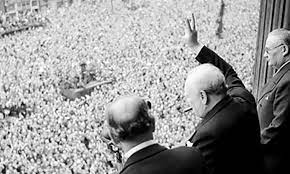
(The photo shows Ernest Bevin on the right of Churchill, 8 May 1945)
The Left and that includes the very influential Zionist left have succeeded in wiping out a substantial chunk of working-class history namely the crucial contribution made by Ernest Bevin. This will come as no surprise to dedicated readers of this magazine but how often have you dear reader heard anyone else mention him?
In the immediate post-war labour government Ernest Bevin reluctantly became Foreign minister. Ernest Bevin was labelled for the rest of his life and for evermore an anti-Semite. He was appalled by the treatment and lack of consideration for the Arabs, and concluded Zionism was racialist.
Bevin was of the opinion that Zionism “demanded far more from the Arabs than they could or should be expected to accept peacefully, that its success would condemn the Middle East to decades of hatred and violence. ” “Publish it Not” Christopher Mayhew and Michael Adams p 17.
Has this not been confirmed by Zionism’s record in power over the subsequent nearly 80 years ?
There can be no doubt he was as much on the side of the Palestinians as Jeremy Corbyn and suffered the same fate at the hands of the Zionists, both falsely accused of being anti-Semitic. What is ironic is that in Bevin’s case some of those who Corbyn would have admired were at the time pro-Zionist; Nye Bevan, Michael Foot, Harold Laski and Kingsley Martin, all essentially of the left. Harold Laski and Kingsley Martin mounted an Antisemitic smear campaign against Bevin which stuck.
Even more ironic the policies Corbyn stood for were a pale version of those Attlee and Bevin pioneered and which were enacted by the 1945 Labour Government. Bevin has been given no credit for his crucial part and this is due to his being labelled anti-Semitic and right-wing all those years ago.
Bevin got legislation passed during the war which helped facilitate the welfare state that was established after the war. Namely his White Paper on Full Employment which was passed by the coalition war government. He told the men of the 50th division had said to him on the eve of embarkation: ‘ Ernie, when we have done this job for you, are we going back to the dole? Conservative members shocked at the familiarity, interrupted: “Ernie?” they queried. Yes, Bevin answered, it was put to me in that way because they knew me personally. They were members of my own union and I think the sense in which the word Ernie was used can be understood ‘
Bullock p370.
Bevin facilitated Beveridge write his report which raised post war expectations and became immensely popular during the war years; as the Economist remarked at the time… the Beveridge Report had not been much more than a projection of familiar principles; the White Paper Employment Policy represented a much more revolutionary change in state ppolicy.
The Zionist influence in the Labour Party at this time is well illustrated by this National Executive Committee report passed in the Labour Party Conference in 1944 which stated :-
” Palestine surely is a case, on human grounds and to promote a stable settlement, for a transfer of population. Let the Arabs be encouraged to move out as the Jews move in. Let them be compensated handsomely for their land and let their settlement elsewhere be carefully organised and generously funded. The Arabs have very wide territories of their own; they must not claim to exclude the Jews from this small part of Palestine, less than the size of Wales. Indeed we should examine also the possibility of extending the present Palestinian boundaries by agreement with Egypt, Syria or Transjordan.”
1944 Annual General Conference Report p9.
When Bevin became Foreign Minister in 1945 the situation was dire. The war had cost Britain £7,300 million a quarter of her national wealth. Her debt increased from £476 million in August 1939 to £3,355 million in June1945; Lend Lease, the crucial support which many assumed would continue after the war was abruptly curtailed; the situation was described by Maynard Keynes as “without exaggeration a financial Dunkirk”. Britain was suffering a food shortage and a financial crisis, with bread rationing being reintroduced. As US loans including the Marshall Plan were being negotiated, President Truman made it clear, any relief was conditional upon 100,000 Jewish immigrants being immediately admitted to Palestine. An angry Attlee and Bevin had no alternative but to comply despite the unbearable stress this would put on the British administration and army in a Palestine on the verge of civil war. Which this measure would surely make more likely.
Despite all this Labour stuck to its promises. In the words of Alan Bullock:
“(I)n 1945 Labour had captured 393 out of 640 seats against the Tories 213, with an unassailable majority over all parties of 146. For those who had spent their lives working for the Labour movement the Promised Land seemed at last in sight and the establishment of a ‘socialist commonwealth’ only a matter of time.
There were good reasons for this. No previous British Government in modern times ever carried through such a series of reforms and no Parliament faced such a crowded timetable of legislation. In the first nine months, Attlee told the Party Conference in 1946, 75 bills had been introduced and 55 had received the Royal Assent. In all, the Parliament elected in 1945 put 347 Acts on the Statute Book. The implementation of the Beveridge Report ( which has been described as the real ‘social gospel ‘ of the 1940s); the creation of the National Health Service and the welfare state and the commitment to full employment and economic planning; the nationalisation of coal, steel, transport and power industries; the transformation of the Empire by the granting of independence to India, Burma, and Ceylon; the retention of controls, rationing and food subsidies (the wartime policy of ‘fair shares’) to regulate the transition from war to peace – all these could be viewed by the Left as the first stage in the introduction of socialism and by the majority of the Parliamentary Party and Labour voters as carrying out Labour’s election programme pretty well to the letter……………….. The result was not a socialist revolution in any Marxist sense or a socialist society, but when added to the changes which has already occurred during the war it left Britain in 1950 a very different country, with its welfare state and mixed economy, from the Britain of the thirties and for Labour’s working-class supporters at least a better one. This was achieved in face of external conditions far worse and a loss of economic and financial power far greater than anyone had foreseen.”
Ernest Bevin by Alan Bullock single volume p396.
Meanwhile the Zionist influence in the Labour Party increased. The extent is illustrated by an unbelievable, and possibly treasonous event which took place while Labour was still in control of Palestine.
“One day, Crossman, now in the House of Commons, came to see Strachey. The former was devoting his efforts to the Zionist cause, He had heard from his friends in the Jewish Agency that they were contemplating an act of sabotage, not only for its own purpose but to illustrate to the world their capacities. Should this be done, or should it not? Few would be killed but would it help the Jews? Crossman asked Strachey for his advice and Strachey a member of the Defence Committee of the cabinet, undertook to find out. The next day in the Smoking Room at the House of Commons, Strachey gave his approval to Crossman. The Haganah went ahead and blew up all the bridges across the Jordan River. No one was killed, but the British Army in Palestine was cut off from their lines of supply in Jordan”.
Professor Hugh Thomas “John Strachey ” p228-229.
I knew a woman whose father was killed by a Jewish terrorist organisation while serving as a soldier in Palestine. She was bitter that his memory was not really properly acknowledged. There was more than a hint of shame attached to it.
In defence of Bevin against the charge of antisemitism it was pointed out at the time that the Bevins had for a number of years lived in Golders Green and had had many Jewish friends there. Of course this would not hold much water today, for it would no doubt be objected that they were possibly all Self-Hating Jews. Come to think of it, by the logic of these times, do not all those East End Jews who opposed Zionism in the thirties deserve to be so categorised?
Note: More on Ernest Bevin in Peter Brooke’s website http://www.labour-values.com
 Labour Affairs