Michael Murray
Introduction: “An bealach seo atá romham” – my destiny
Over the desk of Blinne Ní Ghrálaigh, In the busy London office of Matrix (Barristers’ ) Chambers, on the Greys’ Inn Road – also of Brussels and Geneva, hangs a framed pamphlet with a photograph on its cover of a smiling twelve year old girl: Majella O’Hare shot in in the back in 1976, at the height of the conflict in northern Ireland, by one of a group of British soldiers.
“I was 12 years old myself when I found at the pamphlet about Majella O’Hare in one of my mother’s bookcases. I saw the picture of the young girl on the front, and saw her age, and I read it from cover to cover. I read about how she died in the arms of her father after he heard the shot and went running to her. I think it was her age, the fact that nobody had been held accountable, and the circumstances of the killing – that she had been shot as she walked along a country road with a group of other children, going to Confession at the local chapel – that particularly outraged my convent schoolgirl sensibilities at the time.”
Blinne went to her mother in tears and asked how such a terrible thing could be allowed to happen. Her mother’s response was: “Do something about it”. And she did. By a circuitous route she became a human rights lawyer and known to the wider world through her role in the South Africa legal team which took Israel to the International Court of Justice.

Majella O’Hare
Craig Murray is a former British Ambassador to Uzbekistan who resigned from his post as a protest against western – including UK – support the brutal Uzbek dictatorship. (That was under a Blair government, incidentally) Now a human rights activist, he was one of the few independent bloggers to gain entrance to the tiny public gallery of the ICJ, to hear the South African “Application.”
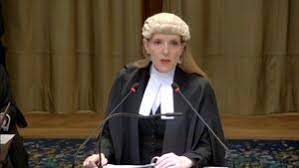
He writes: “Undoubtedly the highlight of the entire morning was the astonishing presentation by Irish KC Blinne Ni Ghràlaigh.
“Her job was to demonstrate that if the Court did not order ‘provisional measures’, then irreparable damage would be done.
“I cannot adequately convey to you the impression she made in that courtroom. Like the rest of the team she eschewed atrocity porn and set out the simple facts plainly but elegantly. She adopted the ploy used by all the South African team, of not using emotional language herself but quoting at length deeply emotional language from senior UN officials. Her outline of daily deaths by type was devastating. I simply urge you to listen to her.”
Blinne Ní Ghrálaigh, Human Rights advocate had arrived on the world stage.
“And,” she says, I’ve hung on to that Majella O’Hare pamphlet over all these years. …. as a reminder of what brought me here.”
An Phalaistín
Her mother, Neasa, whom Blinne acknowledges as a powerful source of her social and cultural and political values – and rearing her with Irish – died in 2011. The funeral arrangements included contributions to the Palestine Solidarity Campaign, in place of flowers.
That was two years after another defining moment in her life: participating in a UN legal observation mission in Gaza following Israel’s military invasion, known as Operation Cast Lead. (My God! What arrogance in that title: what blatancy!)
“The level of devastation and trauma I witnessed in Gaza is hard to put into words. It was one of the experiences of my professional life that has marked me the most,” she said, in an interview to mark an earlier achievement award: Irish Legal News, “Lawyer or the Month.”
A number of cases are mentioned in that interview which illustrate the career of Blinne; they are all of a genre: “Given what drew me to the law,” Blinne says, “I was never going to do corporate law or anything like that. Human rights law and international law are very much at the core of all the work I do.”
The Colson four
Chief amongst them is the Colson Four case, concerning the toppling and dumping in the dock of the statue of a prominent Bristol slave trader during a Black Lives Matter protest in June 2020.
The points of law raised in the case are a very interesting insight into the workings of the law and, no doubt, intended by Irish Legal News to be instructive for its professional readership as well as demonstrating Blinne Ní Ghrálaigh’s legal nous.
This knowledge may also be welcomed by trade unionists, social and community activists being targeted by legislation coming from both government and opposition (by default) to limit free speech, freedom of association and the right to strike.
“While the Colston Four did not deny toppling the statue” The Irish Legal News says, “they relied on a number of “lawful excuses” to the charge of criminal damage. Blinne Ní Ghrálaigh was able to draw on her previous experience, including acting for anti-arms fair protesters in the case of Director of Public Prosecutions v Ziegler. This was a seminal Supreme Court case, which clarified that freedom of speech and freedom of assembly rights could provide a defence to a protest-related criminal charge.
The Colston Four relied on the same “lawful excuse” defence as in Ziegler. Ms Ní Ghrálaigh and other legal representatives argued that a conviction for criminal damage would not be a proportionate restriction of the defendants’ protest-related rights in the context of the case. They also asserted a defence of “belief in consent”, on the basis that they honestly believed that the citizens of Bristol – who had erected the statue, and on whose behalf it was held on trust by Bristol City Council – would have consented to the statue’s removal.
They further relied on the defence of the prevention of crime, on the basis that they honestly believed that the display of the statue of the slaver – responsible for the enslavement of an estimated 84,000 black people and the deaths of 20,000, including many young children – with a plaque celebrating him as one of “the most wise and virtuous sons” of Bristol was criminally offensive, and constituted an “indecent display”.
Other matters the jury had to consider were whether the bronze statue had been damaged in the toppling, and if so, whether the Colston Four had the intention to damage it in removing it.
In a well-publicised verdict – and another victory for Ms Ní Ghrálaigh – the jury in Bristol acquitted the protestors.
Bloody Sunday Inquiry
Blinne was legal observer on the Bloody Sunday Inquiry in Northern Ireland. The inquiry was investigating the events of 30 January 1972, when British soldiers shot dead 14 unarmed civil rights protestors in Derry, in the north of Ireland.
She made the move from London to Derry, spending a year as a legal observer and another year working for a solicitor’s firm representing many of the families of the Bloody Sunday dead and the wounded.
“It was an immense privilege to be part of that historic legal process, and to get to represent and know the families, a number of whom remain friends to this day,” she told Irish Legal News. “Their unwavering dignity, resilience and steadfastness in seeking truth and justice over so many years was and remains utterly inspirational.”
The last word
Nimer Sultany is a Palestinian citizen of Israel, and reader in public law at SOAS University, London. He writes:
“For too many men, women and children in Gaza, this (ICJ) intervention will be too little, too late. But as Blinne Ní Ghrálaigh, the formidable Irish lawyer representing South Africa, argued in the hearing, what is at stake is saving many more lives. Without a halt to Israeli military activity, there will be no end to the decimation of Gaza and the destruction of Palestinian people.”
“Should the court fail to act,” Sultany says, “it would be departing from its own previous rulings and the reputation of international law will further be tarnished. The court must now rise to that challenge.”
Whether it does “rise” to the challenge we will know shortly. Attached as an Appendix is a list of the “provisional measures” South Africa is asking for, and to which there should be a response from the ICJ shortly. With it, Labour Affairs readers will be in a position to evaluate the ICJ verdict for themselves. Whatever the outcome of the South African Application to the ICJ, Blinne Ní Ghrálaigh has placed herself on the winning side of yet another case – in the court of public opinion.
Nesrine Malik, is a Guardian contributor of Sudanese origin.
She writes: “It matters less what the final ruling is than that the case was made in the first place. You can agree or disagree on whether the legal hurdle for genocide has been met (or whether it even matters, if Israel and its allies will disregard it anyway), but in making a submission that recognises the seriousness of events – and that the seriousness of those events may amount to genocide – enough is presented to clearly illustrate that the international response has fallen shockingly short.
“The ICJ case shows how western logic is wearing thin and its persuasive power waning in a multipolar world. The significance of the fact that the country bringing the case is South Africa – an icon of the ravages of colonialism, settlement and apartheid – cannot be lost on anyone. It symbolises a vast racial injustice, too raw and recent to be dismissed as ancient history. In the figure of Nelson Mandela, there lies an evocative example of moral clarity undimmed by persecution. It is no surprise that the support expressed for South Africa is entirely from countries in the global south.” (Guardian, 15 January, 2024)
As Craig Murray has said:”It’s the court that is on trial. The whole world has been observing the genocide. It’s not a question. The only question is, will the court do the unthinkable and acknowledge reality.”
More than the ICJ is on trial.
Before the ICJ has completed its deliberations, leading western powers, led by the US, have intimated they will accept nothing but a rejection of the South African Application.
More than that, even before the Application was heard it was dismissed by the US as “Meritless, counter-productive and completely without any basis in fact.” And Netanyahu has reasserted the Zionist goal: Israel “From the River to the Sea,” an open admission of genocidal intent – which Israel knows won’t endanger the flow of weapons and financial support from the West. Not in the short term anyway. In the longer term?
Biden once said that “If Israel didn’t exist, we’d have to invent an Israel to look after our interests in the middle east.” Re-inventing Israel seems like the best option for the US. But that seems a long way off, given the shit-show that is the US polity.
Appendix: List of “provisional measures” sought in South African Application to the ICJ:
(1) The State of Israel shall immediately suspend its military operations in and against Gaza.
(2) The State of Israel shall ensure that any military or irregular armed units which may be directed, supported or influenced by it, as well as any organisations and persons which may be subject to its control, direction or influence, take no steps in furtherance of the military operations referred to point (1) above.
(3) The Republic of South Africa and the State of Israel shall each, in accordance with their obligations under the Convention on the Prevention and Punishment of the Crime of Genocide, in relation to the Palestinian people, take all reasonable measures within their power to prevent genocide.
(4) The State of Israel shall, in accordance with its obligations under the Convention on the Prevention and Punishment of the Crime of Genocide, in relation to the Palestinian people as group protected by the Convention on the Prevention and Punishment of the Crime of Genocide, desist from the commission of any and all acts within the scope of Article II of the Convention, in particular:
(a) killing members of the group;
(b) causing serious bodily or mental harm to the members of the group;
(c) deliberately inflicting on the group conditions of life calculated to bring about its physical destruction in whole or in part; and
(d) imposing measures intended to prevent births within the group.
(5) The State of Israel shall, pursuant to point (4)(c) above, in relation to Palestinians, desist from, and take all measures within its power including the rescinding of relevant orders, of restrictions and/or of prohibitions to prevent:
(a) the expulsion and forced displacement from their homes;
(b) the deprivation of:
(i) access to adequate food and water;
(ii) access to humanitarian assistance, including access to adequate fuel, shelter, clothes, hygiene and sanitation;
(iii) medical supplies and assistance; and
(c) the destruction of Palestinian life in Gaza.
(6) The State of Israel shall, in relation to Palestinians, ensure that its military, as well as any irregular armed units or individuals which may be directed, supported or otherwise influenced by it and any organizations and persons which may be subject to its control, direction or influence, do not commit any acts described in (4) and (5) above, or engage in direct and public incitement to commit genocide, conspiracy to commit genocide, attempt to commit genocide, or complicity in genocide, and insofar as they do engage therein, that steps are taken towards their punishment pursuant to Articles I, II, III and IV of the Convention on the Prevention and Punishment of the Crime of Genocide.
(7) The State of Israel shall take effective measures to prevent the destruction and ensure the preservation of evidence related to allegations of acts within the scope of Article II of the Convention on the Prevention and Punishment of the Crime of Genocide; to that end, the State of Israel shall not act to deny or otherwise restrict access by fact-finding missions, international mandates and other bodies to Gaza to assist in ensuring the preservation and retention of said evidence.
(8) The State of Israel shall submit a report to the Court on all measures taken to give effect to this Order within one week, as from the date of this Order, and thereafter at such regular intervals as the Court shall order, until a final decision on the case is rendered by the Court.
(9) The State of Israel shall refrain from any action and shall ensure that no action is taken which might aggravate or extend the dispute before the Court or make it more difficult to resolve it.
 Labour Affairs