Brendan Clifford
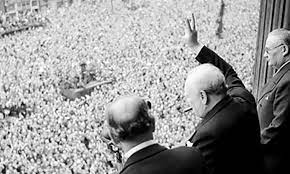
(The image above shows Ernest Bevin to the right of Churchill, 8th May 1945)
The NHS was established as a Communist service for a capitalist economy, made possible by the proceeds of Empire. It was a realisation of the safety net envisaged by the manufacturing capitalist, Joseph Chamberlain, in the 1880s. Chamberlain was convinced that the working class would not in the long run tolerate the laissez faire system. He urged that life should be made tolerable within the capitalist system by means of a safety net. He broke with the Liberal Party, the party of pure capitalism, on the issue, and joined forces with the Tories. The Tories were the party that first established legal restrictions on the operation of capitalist enterprise. The merger of the Tories with the social reform Liberals was called the Unionist Party.
The conflict of Unionism and Liberalism sharpened almost to the point of civil war on the issue of Ireland, when a Unionist Government had enacted extensive social reforms. In the course of that conflict, the Liberal Party came to adopt the position it had rejected in the 1880s. When it wrecked itself by the way it launched and conducted the Great War, and the Labour Party suddenly emerged as the second party, many eminent Liberals became socialists for the purpose of both making Labour an effective governing party and narrowing its governing horizons.
For most of the period between 1924 (when Labour first formed a Government) and 1945 Labour acted in a National Coalition with the Unionists (which had been calling themselves Tories since 1922) and remnants of the Liberal Party.
There has never been a clear class development of British politics, except perhaps for the Liberal/Capitalist era following the Great Reform.
Labour was effectively in power domestically under Churchill in 1940-1945. Churchill was an Imperialist rather than a Capitalist. He gave the domestic economy to the Trade Union boss, Ernest Bevin, to run. Bevin had built up working class power within Capitalism during the twenties and thirties, and it was as a Trade Union boss accustomed to making deals with capitalists that he became a senior Cabinet Minister in 1940 before becoming a Member of Parliament.
He remained unparliamentary in his ways, and was subject to harassment by the Labour Left, which was very Parliamentary in mode. And it was under Bevin, within the general Churchillian atmosphere, that the country became accustomed to being ordered about by a Socialist.
In May 1945 there was doubt about whether Party government would be resumed after a long suspension, or whether National Government would continue. Either way something like the Welfare State would have been established. The foundations were laid during the War.
Imperialism was common ground of effective British party politics in 1945. Aneurin Bevan, the Left Labour Parliamentary Socialist, stood on it no less than Ernest Bevin. But Bevin was taken out of British politics by Attlee and given the job of maintaining the British position in the world.
Bevan was an administrator rather than a statesman. He would, if he could, have established the NHS as a comprehensive State service, without private admixture, but he was unable to do so. The medical profession insisted on remaining a profession. He was obliged to make two compromises with it. The GPs cooperated with it only on the condition that they retained independent status, and Consultants acted within it only on the condition that they could use its facilities for private practice.
The NHS was never a comprehensive system free to all on an equal basis. Money always counted for something within it. As a free service it was subject to a degree of rationing. Infinite resources could not be on tap—even with the proceeds of Empire—and if the system had been strictly national—unsupported by Empire—it would have had to be constructed in a different way.
With money one could jump the queue. But it is far from certain that the system would be improved by the abolition of private medicine—and the ethos of a profession along with it.
The presence of the private element rankled ideologically. As soon as the system was established, the Keep Left element in the Labour Party made an issue of teeth and spectacles, and means testing. Later on the contentious issue was the arrangement with the Consultants.
The NHS was constructed as a Communist service for a capitalist society. It has therefore an element of rationing in it. Is that element of rationing maximised or minimised by the fact that it is a service for a capitalist society rather than a Communist society?
It is organised as a managerial bureaucracy. How else could it be organised? Communist society, to the extent that it was ever established, was a very complex system of committees. It was a vast bureaucracy which was soon found to have a problematical dynamic.
Trotsky berated Lenin for ten years before 1917 as a bureaucrat who would stunt the free flow of mass activity. After 1917 he spent about five years collaborating with Lenin in establishing a Communist or Socialist State as a network of committees. When Lenin felt that he was dying he appealed to Trotsky to take over direction of the system. It appears that it was only then that Trotsky became aware that the system was constructed as a hierarchy of committees—a bureaucracy.
He refused to become Lenin’s heir. He did not explain why. And he never tackled the problem of how the freedom of Capitalism can be combined with Socialist order.
 Labour Affairs